
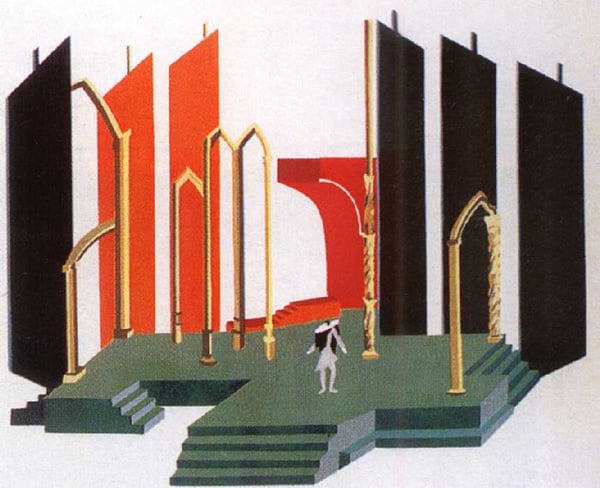
Don Juan, and death. Sheet of from the album "Theater Set"
Ayrıntılar
Aleksandra Ekster sanatçısının Don Juan, and death. Sheet of from the album "Theater Set" eseri hakkında uzman analizi
Tarz: Constructivism · Tür: design
Expert Analysis: The Constructivist Theater Design of Aleksandra Ekster
Aleksandra Ekster’s Don Juan, and death. Sheet of from the album "Theater Set" stands as a quintessential example of Constructivist stage design, merging avant-garde geometric abstraction with the functional demands of theatrical narrative. Executed in the Constructivist style—a Russian avant-garde movement that championed industrial materials, dynamic composition, and the integration of art into everyday life—this work transforms the classical tale of Don Juan into a radical visual experiment.
Significance within Constructivism and Design Genre:
-
Breaking with Tradition: Ekster rejects the illusionistic, painted backdrops of traditional theater. Instead, she employs sharp angular lines, overlapping planes, and a stark interplay of light and shadow to convey the psychological tension between Don Juan and death. The composition is non-representational yet deeply expressive, using abstract forms to suggest movement, conflict, and the existential threshold of mortality.
-
Functional Abstraction: True to Constructivist ideals, every element serves a purpose. The sheet likely functioned as a guide for set construction—a blueprint of geometric modules that could be assembled, disassembled, or manipulated by actors. This modularity reflects the movement’s belief in art as a tool for social and spatial transformation.
-
Dynamic Tension: The title’s pairing of “Don Juan” (the libertine hero) with “death” is visualized through contrasting shapes: a diagonal thrust (representing defiant energy) colliding with a descending, weighty mass (symbolizing mortality). Ekster exploits the Constructivist vocabulary of lines, circles, and arcs to create a visual dialectic—a hallmark of her stage designs for avant-garde productions.
-
Legacy in Theatrical Modernism: Ekster’s theater album (of which this sheet is a part) was a pioneering fusion of fine art and industrial design. By treating the stage as a Constructivist object—not a window into a fictional world—she influenced later modernist set designers and solidified the role of the artist as an engineer of space. This work encapsulates how Constructivism redefined design as a dynamic, participatory medium, making it a significant artifact of early 20th-century avant-garde theater.
Görsel olarak benzer
İlişkili kompozisyon ve renk paletine sahip 20 eser
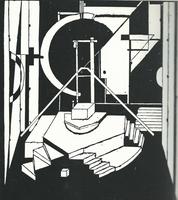
Stage A.Gide, dramas
M. H. Maxy
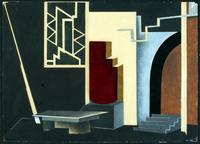
Library in the House of da Silva (set design for Uriel Acosta)
Nathan Altman
Untitled
Minas Avetisyan
Gouache
Francis Bacon
The Sun of the October Revolution Has Risen
Nathan Altman
Décor de Thêatre pour Les Euclides
Leopold Survage
Design for the Cochrane review
Christopher Wood
Gate to the Garden. Alice in Wonderland
Oleksandr Aksinin
Monitor
Enrico Pinardi

Portalerna
Sven Jonson
Illustrations for The Trial by F. Kafka
Oleksandr Aksinin
Design for the Cochrane review
Christopher Wood
The Master Builder
Petre Otskheli
Don Quijote
Esteban Frances
La salamandra, bozzetto di scena
Enrico Prampolini
Palacios en Bría
Xul Solar
Old Brooklyn Bridge
Joseph Stella
Gospel
Oleksandr Aksinin
Venice
Aleksandra Ekster
Gospel
Oleksandr Aksinin