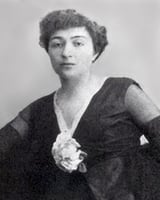
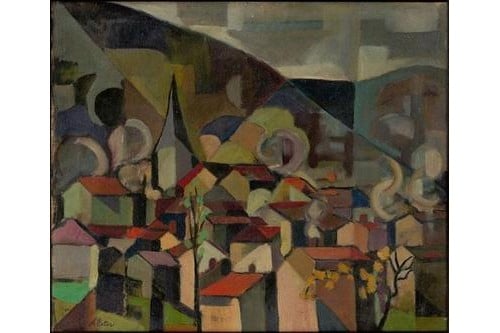
Expert analysis of Aleksandra Ekster’s View of the bridge
Style: Cubo-Futurism · Genre: cityscape
Expert Art Historical Analysis: "View of the bridge" by Aleksandra Ekster
Aleksandra Ekster’s "View of the bridge" is a striking example of Cubo-Futurist cityscape painting, a style that synthesizes the geometric fragmentation of Cubism with the dynamic, mechanistic energy of Futurism. Within this context, the work is significant for several key reasons:
-
Synthesis of Movements: As a leading figure in the Russian avant-garde, Ekster bridges Western European Cubism (particularly the planar dissection of form) and Italian Futurism (obsession with speed, light, and modern urban life). The painting’s composition likely fractures the bridge and its surroundings into angular, overlapping planes while simultaneously suggesting movement—a hallmark of Cubo-Futurism that distinguishes it from static Cubist still lifes.
-
Urban Dynamism: The choice of a bridge as subject allows Ekster to explore infrastructure as a symbol of modernity. The bridge is not a passive structure but an active participant in the city’s rhythm, its lines and vectors pulling the viewer’s eye across the canvas. This aligns with the Futurist celebration of technology and the Cubist deconstruction of perspective, creating a visionary urban landscape that feels both analytical and kinetic.
-
Color and Rhythmic Structure: Ekster was renowned for her vibrant, often non-naturalistic color palettes. In "View of the bridge", color likely functions architecturally—delineating faceted volumes while also generating optical vibration, a technique that later influenced Constructivist and stage design. The interplay of warm and cool hues would amplify the sense of restless, modern energy.
-
Position in the Avant-Garde: While her male contemporaries (Malevich, Tatlin) are often foregrounded in art history, Ekster’s cityscapes are crucial to understanding Cubo-Futurism’s shift toward abstraction and its intersection with decorative arts. This work exemplifies how she applied Cubo-Futurist principles to the cityscape genre, transforming a mundane view into a fractured, luminous meditation on urban perception.
In summary, "View of the bridge" is significant because it crystallizes Cubo-Futurism’s core ambitions: to dismantle and reanimate the visual world through geometry, rhythm, and color, while placing the modern city at the center of a new, revolutionary art.
Museum / Gallery
Visually similar
20 works with related composition and palette
Mallorca
Else Berg
Egry József, Hegyoldal,.
Egry József
Bela Adalbert Czobel, Cagnes
Bela Czobel
Předměstí (Marseille)
Josef Capek
Pintura
Menez
Landscape with red and yellow
Raoul Dufy
Tunk Mountains, Autumn, Maine
John Marin
Czóbel Béla Törökvölgy
Bela Czobel
Czobel Bela Törökvölgy Szentendrén
Bela Czobel
Houses with Pointed Roofs
Chaim Soutine
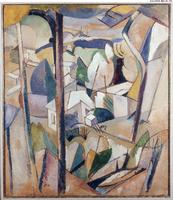
Untitled
Albert Gleizes
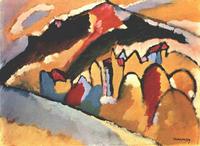
Study for autumn
Wassily Kandinsky
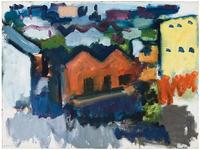
Hills and Buildings, Folsom Street, San Francisco
Robert De Niro, Sr.
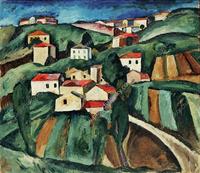
Near Siena
Pyotr Konchalovsky
View of Ceret
Chaim Soutine
Aliagne mon village
Cricorps
Cagnes
Bela Czobel
Landscape at Ferte Soud Jouarre
Roger de La Fresnaye
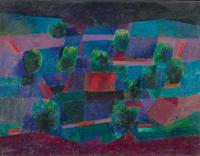
Moonlit Landscape
Johannes Itten
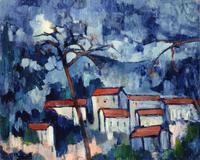
Landscape with Red Roofs
Maurice de Vlaminck