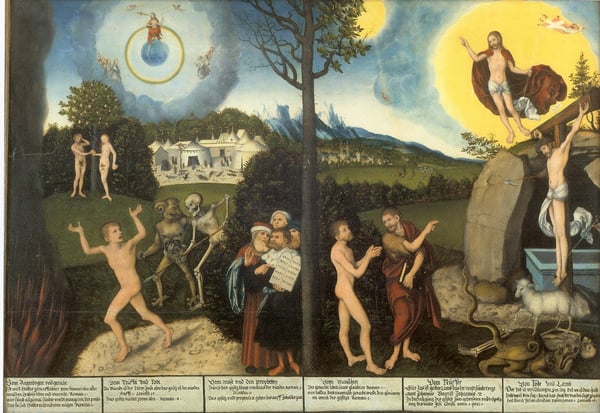
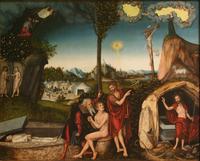
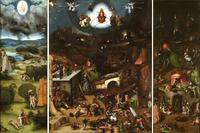
This artwork, “Law and Grace” by Lucas Cranach the Elder, is a masterpiece of the Northern Renaissance and a seminal document of Reformation theology. Painted around 1529, it is significant for its clear, didactic visual argument—a hallmark of Cranach’s role as a close friend and propagandist of Martin Luther.
Composition and Symbolism: The painting is split by a central tree: on the left, the “Law” side, a bleak landscape shows Moses holding the tablets, Adam and Eve committing original sin, and Death and a demon driving a naked sinner toward the flames of Hell. This side emphasizes human despair under the Old Testament law. On the right, the “Grace” side features John the Baptist pointing past the crucified Christ to the risen Savior, with the Lamb of God and a dove (Holy Spirit) above. A sinner is cleansed by blood from Christ’s side, and the scene ends in a peaceful heavenly city.
Significance: This work is a visual manifesto of Luther’s doctrine of sola fide (justification by faith alone). Cranach’s genius lies in translating complex theology into an accessible, almost diagrammatic narrative, a technique that made religious instruction vivid for a largely illiterate audience. Its stark contrasts—death vs. life, condemnation vs. redemption—epitomize the Northern Renaissance’s blend of precise, naturalistic detail with profound symbolic meaning. “Law and Grace” is not just a painting; it is a theological argument that helped shape the visual culture of the Protestant Reformation.