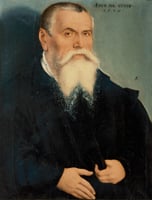
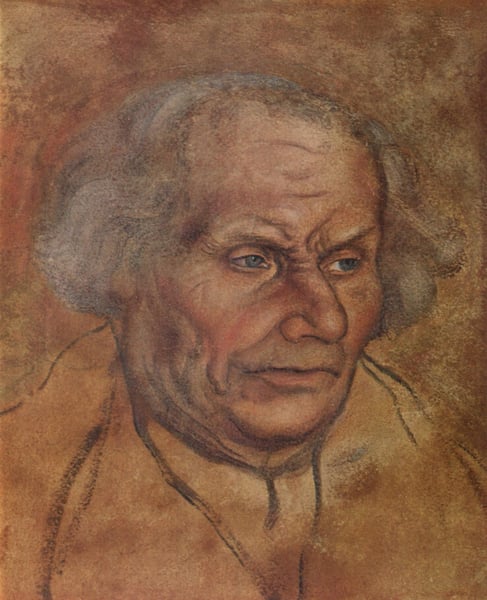
Analisi esperta di Portrait of Luther's Father di Lucas Cranach the Elder
Stile: Northern Renaissance · Genere: portrait
Expert Analysis: "Portrait of Luther's Father" by Lucas Cranach the Elder
This portrait is a significant work within the Northern Renaissance, a period defined by meticulous realism, symbolic detail, and a growing interest in individual likeness. Lucas Cranach the Elder, a leading German painter of the era, is here documenting a figure of profound historical importance: the father of Martin Luther, the instigator of the Protestant Reformation.
Significance within the Northern Renaissance:
As a Northern Renaissance portrait, this work embodies the movement’s commitment to precise, unidealized representation. Cranach’s style—known for crisp outlines, careful modeling of facial features, and a restrained yet rich color palette—serves to capture the sitter’s character and social standing with sober dignity. Unlike Italian Renaissance portraits that often idealized form, Cranach’s approach emphasizes verisimilitude and psychological presence, placing the subject firmly in his earthly, tangible world.
Historical and Iconographic Importance:
The portrait’s true significance lies in its subject. By depicting Luther’s father, Cranach connects the personal lineage of the Reformation’s leader with the broader religious upheaval. Martin Luther’s father, a copper miner who rose to some prosperity, represents the emerging burgher class that fueled Reformation ideas. Cranach, a close friend of Luther and a prolific portraitist of Reformation figures, used his art to humanize and legitimize the movement’s leaders and their families. This work thus functions not only as a faithful likeness but as a visual document of the social and religious forces reshaping Europe.
Artistic Legacy:
Within Cranach’s oeuvre, this portrait exemplifies his skill in balancing formal portraiture with intimate characterization. The careful rendering of age, clothing, and expression speaks to the Northern Renaissance’s fascination with the individual as a vessel of both personal and historical meaning. It stands as a testament to how portraiture during this period served to immortalize key figures in the burgeoning Reformation narrative, making it a crucial piece for understanding the intersection of art, religion, and identity in 16th-century Germany.
Museum / Gallery
Visivamente simili
20 opere con composizione e palette affini
Study to the portrait of Jean Le Rond d'Alembert
Maurice Quentin de La Tour
Portrait of a Bavarian man
Anton Azbe
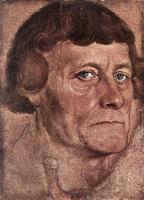
Portrait of a Man
Lucas Cranach the Elder
Autoretrato
Vlady
Head of Breton, Study for Pardon
Jules Breton
Study of the Head of a Blind Man
Gustav Klimt
Portrait of Pope Pius VII
Vincenzo Camuccini
Head of an old man
Pellizza da Volpedo
George Nevill, 3rd Baron Bergavenny
Hans Holbein the Younger
Portrait of Cardinal Albergati
Jan van Eyck
Portrait of Antoine Jecker
Carolus-Duran
Head of a Peasant (Study for the Potato Eaters)
Vincent van Gogh
Cardinal Mercier
Paul-Albert Besnard
Portrait-study of an old man
Ernst Meyer
Portrait of an Old Man in Profile (Count Traun)
Gustav Klimt
Autoritratto
Ottone Rosai
The Blind Man
Gustav Klimt
Self-portrait
Maurice Quentin de La Tour
Studies on a great "picture of Mary ' St. Joseph
Albrecht Durer
Self-Portrait
Ivan Albright