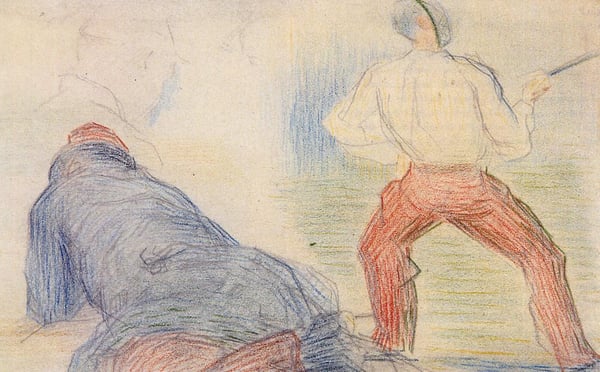
Expertenanalyse zu Georges Seurats Soldier Fencing, Another Reclining
Stil: Post-Impressionism · Genre: sketch and study
Expert Analysis of "Soldier Fencing, Another Reclining" by Georges Seurat
As a sketch and study created within the Post-Impressionist movement, this work by Georges Seurat is significant for revealing the artist’s disciplined, almost scientific approach to composition—a hallmark of his transition from Impressionism’s spontaneity toward a more structured, analytical form of modernism. Unlike Seurat’s finished masterpieces that employ his signature pointillist technique (carefully applied dots of pure color), this study focuses on the fundamental building blocks of drawing: line, tone, and the dynamic relationship between figures.
Composition and Contrast: The drawing juxtaposes two figures in arrested motion and repose. A soldier enacts a fencer’s lunge, while another reclines passively. This binary opposition—active vs. static, vertical thrust vs. horizontal rest—demonstrates Seurat’s interest in rhythm and balance, likely as a preparatory exercise for a larger narrative composition. The energy of the fencer’s pose (arm extended, weight forward) is counterbalanced by the calm, diagonal lines of the reclining figure, creating a tension that would later inform Seurat’s ability to orchestrate crowds in works like A Sunday on La Grande Jatte.
Technique and Significance: Executed primarily in conté crayon on textured paper, the drawing showcases Seurat’s mastery of chiaroscuro. Using dense hatches and velvety black passages against the paper’s tooth, he models volume and movement without relying on color—a departure from Impressionist emphasis on light. Instead, he treats form through abstracted tonal masses, anticipating the geometrization of shape found in later Post-Impressionists like Cézanne. The sketch’s loose, unfinished quality is not a flaw but a deliberate study of gesture: Seurat dissects human energy into almost diagrammatic lines, linking his work to the era’s fascination with motion photography (e.g., Marey’s chronophotography) and the scientific analysis of movement.
Within Post-Impressionism: This study exemplifies Post-Impressionism’s shift from capturing fleeting optical effects to expressing structure, emotion, or symbolic order. Seurat’s focus on the relation between bodies—their spatial dialogue—foreshadows his development of Divisionism, where color and line are systematically arranged to create harmony. As a sketch, it opens a window onto his conceptual process: the raw, cerebral planning behind the luminous canvases that define his legacy. In short, “Soldier Fencing, Another Reclining” is significant not as a finished product, but as a key to understanding how Seurat synthesized observation, geometry, and the poetics of opposition to reinvent modern painting.
Museum / Gallery
Visuell ähnlich
20 Werke mit ähnlicher Komposition und Farbpalette
Study of Three Peasants, One Sitting
Vincent van Gogh
The Floor Scrapers (study)
Gustave Caillebotte
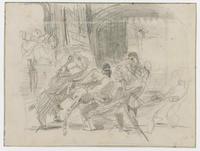
Mazeppa Tied Behind Him on a Wild Horse
Eugene Delacroix
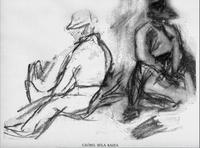
Czobel Lappang................
Bela Czobel
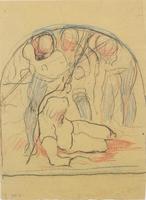
Dying cadet
Ferdinand Hodler
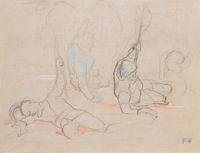
The wounded standard bearer Hans Baer
Ferdinand Hodler
Sheet with Sketches of Peasants
Vincent van Gogh
Study of Two Peasants
Vincent van Gogh
Sketch of a Stooping Man
Vincent van Gogh
Francs-tireurs -study-3288
Theophile Steinlen
The Fight
James Ensor
Koncertas
Vytautas Kairiukstis
Two Wounded Soldiers
Nicolas Toussaint Charlet
Untitled
Hans Bellmer
Diggers in Torn-Up Street
Vincent van Gogh
Travolta a Zurigo
Mario Comensoli
Study of a Back-facing, seated Italian
Ernst Meyer
Peasant
Vincent van Gogh
Seated Female Holding a Book, Two Heads of Bearded Men, Seated Male Nude, and Four Sketches for Christ Judging (recto); Studies for Cain Slaying Abel (verso)
Palma il Giovane
Berény Róbert , Jelenet
Berény Róbert