Expertenanalyse zu Francisco de Zurbarans The Immaculate Conception
Stil: Baroque · Genre: religious painting
Expert Analysis of "The Immaculate Conception" by Francisco de Zurbarán
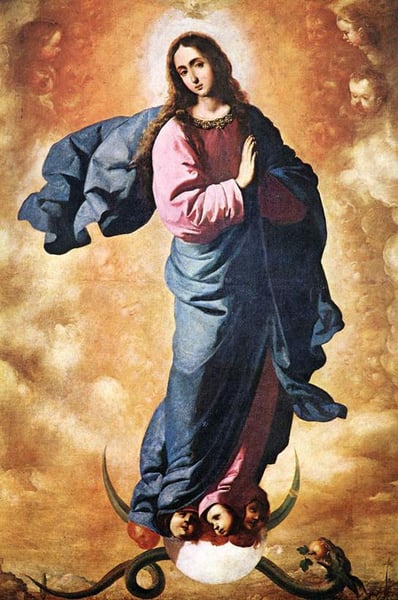
Francisco de Zurbarán’s The Immaculate Conception stands as a defining example of Spanish Baroque religious painting, a work that encapsulates the era’s intense spirituality and technical mastery. Painted during the Counter-Reformation, when the Catholic Church actively promoted the doctrine of the Immaculate Conception—the belief that the Virgin Mary was conceived without original sin—Zurbarán’s interpretation is both theologically precise and emotionally resonant.
Stylistic Significance within the Baroque
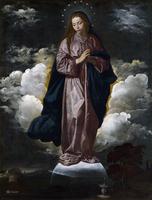
Zurbarán, known for his tenebristic chiaroscuro and almost sculptural rendering of form, here employs a dramatic contrast of light and shadow to elevate the Virgin as a luminous, otherworldly figure. The composition typical of Spanish Baroque religious art: the Virgin stands alone, floating on clouds, her hands clasped in prayer, her gaze modestly lowered. This composition focuses the viewer’s attention solely on her purity and grace. The deep, dark background heightens the spiritual radiance of her figure, a hallmark of Baroque tenebrism borrowed from Caravaggio but adapted for a distinctly devotional tone.
Iconography and Period Context
In accordance with the conventions of the Immaculate Conception imagery—codified by artists like Murillo—Zurbarán includes standard symbols: the crescent moon under her feet, the crown of twelve stars, and a blue mantle representing heaven. However, what sets Zurbarán’s work apart is its rigorous austerity. Unlike the more sentimental versions by Murillo, Zurbarán’s Virgin is a solemn, monumental presence. The fabric of her robe is painted with extraordinary tactile realism—the crisp folds of white and blue seem carved from marble—reflecting his training in the Seville school and the influence of polychrome sculpture.
Significance in Zurbarán’s Oeuvre and Baroque Art
This painting is significant because it exemplifies how Spanish Baroque artists synthesized naturalism with divine mystery. Zurbarán, a master of still-life-like precision, applies that same meticulous observation to the Virgin’s features, making the holy accessible yet awe-inspiring. The work also reflects the theological debates of 17th-century Spain, where the Immaculate Conception was a fiercely defended dogma. By presenting the Virgin as both humanly tangible and celestial, Zurbarán reinforces the Counter-Reformation message that through art, the faithful can experience a direct, emotional connection to the divine.
Thus, The Immaculate Conception is not only a masterpiece of Baroque painting but also a profound visual statement of faith, demonstrating how Zurbarán’s restrained intensity and luminous realism elevate religious iconography into transcendent art.
Museum / Gallery
Visuell ähnlich
20 Werke mit ähnlicher Komposition und Farbpalette
The Immaculate
Jusepe de Ribera
The Immaculate Conception
Francisco de Zurbaran
Immaculate of St. Vincent
Bartolome Esteban Murillo
Immaculate Conception
Alonzo Cano
Inmaculate Conception
Alonzo Cano
Immaculate
Juan del Castillo
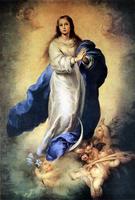
The Immaculate Conception
Bartolome Esteban Murillo
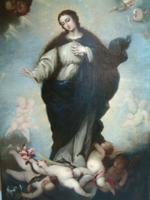
Immaculate Conception
Alonzo Cano
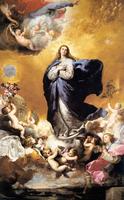
Immaculate Conception
Jusepe de Ribera
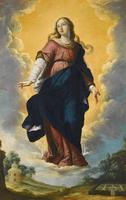
Immaculate Conception
Francisco de Zurbaran
The Immaculate Conception
Bartolome Esteban Murillo
Imaculada Conceição
José Campeche
Maria Immaculata
Leopold Kupelwieser
The Immaculate Conception
Anton Raphael Mengs
The imaculate conception
Juan de Valdes Leal
The Immaculate Conception (oil on canvas)
Bartolome Esteban Murillo
Inmaculada con Miguel del Cid
Francisco Pacheco
Immaculée Conception
Antonio de Pereda
The Immaculate Conception
Diego Velazquez
The Immaculate Conception
Claudio Coello