Expert Analysis: "Virgin Annunciate" (Exterior Right Panel, Ghent Altarpiece) by Jan van Eyck
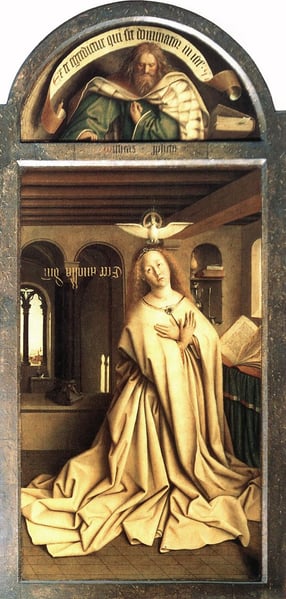
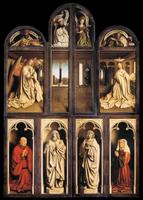
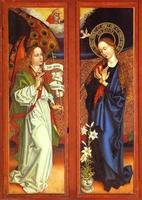
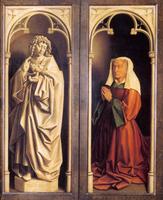
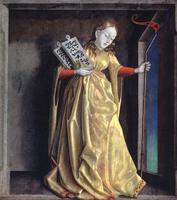
As a masterwork of the Northern Renaissance and a profoundly significant religious painting, this panel exemplifies Jan van Eyck’s revolutionary approach to naturalism and symbolic depth. Executed in grisaille (monochrome painting), the Virgin Annunciate appears as a carved stone statue set within a niche—a trompe-l’oeil illusion that underscores the artist’s unparalleled skill in rendering texture, light, and volume. This deception was intentional: the exterior panels of the Ghent Altarpiece simulate sculpture to create a layered interplay between the real and the painted, the earthly and the divine.
What makes this work extraordinary within its period is van Eyck’s ability to infuse a seemingly static, monochrome figure with psychological presence and theological significance. The Virgin’s modest posture, downcast eyes, and gently raised hand convey humble acceptance of the Annunciation—a moment of Incarnation. The grisaille technique also serves a liturgical function: when the altarpiece is closed, the exterior mimics a sculpted shrine, preparing the viewer for the burst of color and narrative on the interior. This duality—the tension between illusion and reality, stone and flesh, Old Testament law (represented by the grisaille) and New Testament grace (the colorful interior)—is a hallmark of Northern Renaissance innovation.
Van Eyck’s meticulous handling of light, even in monochrome, demonstrates how he elevated oil painting to capture the subtle play of illumination on simulated stone—a feat that influenced generations. The Virgin Annunciate thus stands as a testament to the era’s fusion of meticulous observation, religious symbolism, and technical mastery.