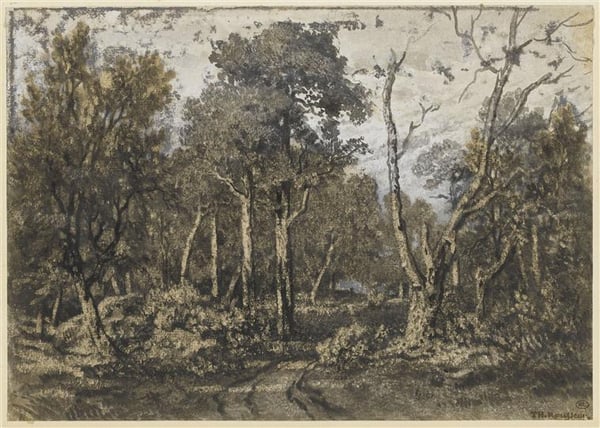
The oak tree crashed into the forest of Fontainebleau
Análisis experto de The oak tree crashed into the forest of Fontainebleau de Theodore Rousseau
Estilo: Realism · Género: landscape
Expert Analysis:
Theodore Rousseau’s The Oak Tree Crashed into the Forest of Fontainebleau stands as a defining work of Realist landscape painting. Created during a period when Rousseau was a leading figure of the Barbizon school, this painting rejects the idealized, pastoral scenes favored by academic tradition. Instead, it confronts viewers with a raw, unvarnished moment in nature—a fallen oak, twisted and broken, lying amidst the dense undergrowth of the forest.
Significance:
- Realism’s embrace of the ordinary and transient: Rather than depicting a majestic, upright oak (a symbol of strength and permanence), Rousseau focuses on its ruin. This choice reflects the Realist commitment to portraying nature as it actually exists—subject to decay, accident, and time. The fallen tree becomes a meditation on mortality and the relentless cycle of growth and collapse.
- Barbizon School innovation: Rousseau’s meticulous observation of light, texture, and atmospheric effect—visible in the rough bark, shifting shadows, and dappled sunlight—helped establish the forest of Fontainebleau as a worthy subject for serious art. His approach paved the way for later plein-air painting and influenced the Impressionists.
- Anti-heroic naturalism: By centering a “crashed” tree rather than a sublime vista, Rousseau challenges the conventional hierarchy of landscape painting. The work elevates a neglected, messy corner of the forest to a monumental subject, asserting that beauty and meaning exist in the unidealized physical world.
This painting is significant not only as a masterful Realist landscape but also as a philosophical statement on nature’s indifference and power. It remains a touchstone for the Barbizon school’s radical shift toward truthfulness over artifice.
Género
Estilo
Visualmente similares
20 obras con composición y paleta relacionadas
The Forest in Winter
Theodore Rousseau
The Forest of Fontainebleau
Theodore Rousseau
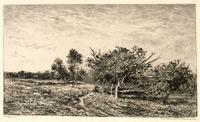
Apple Trees at Auvers
Charles-Francois Daubigny
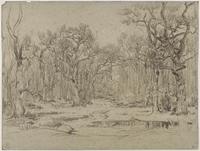
The Forest in Winter
Theodore Rousseau
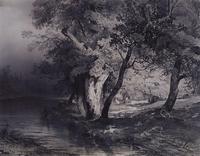
Forest near the lake, illuminated by the sun
Aleksey Savrasov
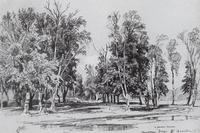
Zelenina grove
Ivan Shishkin
Avenue in the country
Anthony van Dyck
Cornard Wood, near Sudbury, Suffolk
Thomas Gainsborough
Verscheijde Ghesichten, in 't Haechsche Bosch na 't Leven geteyckent
Roelant Roghman
Postwick Grove, Norwich
John Crome
The stream
Ivan Shishkin
Forest path with a carriage
Karl Friedrich Schinkel
Marlingford Grove
John Crome
Row of Trees
Jan Dirksz Both
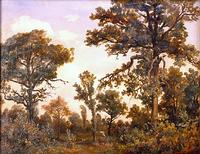
The Large Oak Tree, Forest of Fontainebleau
Theodore Rousseau
Forest
Ivan Shishkin
The Fairy Pool
Narcisse-Virgilio Diaz
Oaks
Ivan Shishkin
Avenue and Castle
John Varley
Landscape
Ralph Blakelock