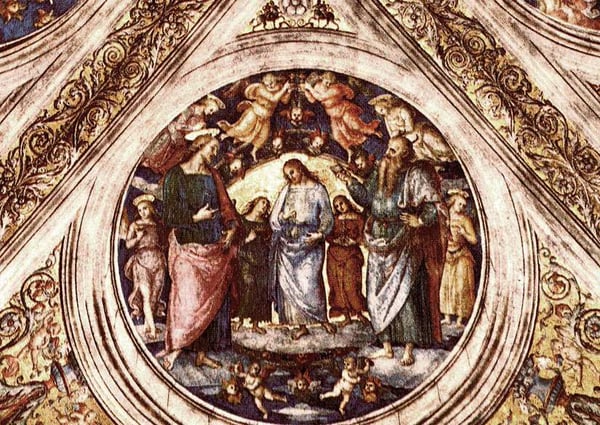
Christ between the Baptist and the Satan disguised as an Old Man
Details
Expertenanalyse zu Pietro Peruginos Christ between the Baptist and the Satan disguised as an Old Man
Stil: High Renaissance · Genre: religious painting
Expert Analysis: "Christ between the Baptist and the Satan disguised as an Old Man" by Pietro Perugino
This remarkable religious painting, executed during the High Renaissance, stands as a compelling testament to Pietro Perugino’s mastery of compositional balance and psychological subtlety. While Perugino is celebrated for his serene, harmonious altarpieces and idealized figures—most famously in the Sistine Chapel—this work introduces a striking narrative tension that sets it apart within his oeuvre.
Significance within the High Renaissance
The High Renaissance prized clarity, order, and the rational arrangement of figures within a coherent space. Perugino adheres to these principles by placing Christ at the compositional center, flanked by two figures of opposing spiritual significance: John the Baptist, the herald of salvation, and Satan, disguised as an old man. This tripartite structure creates a dialectical tension—virtue on one side, deception on the other—while Christ’s central position anchors the scene in a moment of moral decision. The disguised Satan, rather than appearing as a monstrous beast, adopts the guise of a venerable elder, a subtlety that amplifies the psychological drama: evil is not blatant but insidious, cloaked in familiarity.
Iconographic Innovation
Perugino’s choice to depict Satan as an old man is particularly significant for High Renaissance religious art. Traditional medieval and early Renaissance iconography typically rendered the devil with grotesque, animalistic features. By presenting him as a seemingly wise, aged figure, Perugino aligns with the humanist interest in interiority and deception. The old man could be mistaken for a saint or prophet, forcing the viewer to engage in careful discernment—a theme that resonates with the era’s focus on human reason and moral vigilance.
Stylistic Coordination
Even within this unusual subject, Perugino’s signature style is evident: soft, atmospheric light modeling the figures, calm gestures, and a restrained emotional tone. The composition likely avoids dramatic movement, instead relying on the quiet confrontation of gazes and gestures. This understated approach heightens the intellectual challenge of the scene, inviting meditation on the nature of temptation and redemption.
Conclusion
This painting is significant because it demonstrates how High Renaissance conventions—balance, clarity, and idealization—could be harnessed not only for divine serenity but also for theological complexity. Perugino here transforms a standard religious theme into a sophisticated moral allegory, using disguise and composition to explore the very boundaries between good and evil, appearance and reality.
Visuell ähnlich
20 Werke mit ähnlicher Komposition und Farbpalette
The Holy Trinity and the Apostles
Pietro Perugino
God the Creator and Angels
Pietro Perugino
The ceiling with four medallions
Pietro Perugino
Vaulting of the Tornabuoni Chapel
Domenico Ghirlandaio
St. Mark (detail of The Four Evangelists)
Benozzo Gozzoli
View of the chapel vaulting
Fra Angelico
Prophets
Fra Angelico
Vaulting of the Sassetti Chapel
Domenico Ghirlandaio
Doctors of the Church
Luca Signorelli
St. Luke (detail of The Four Evangelists)
Benozzo Gozzoli
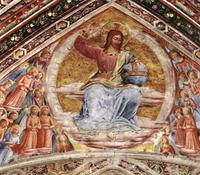
Christ the Judge
Fra Angelico
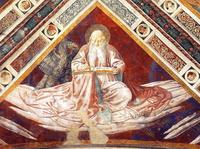
St. John (detail of The Four Evangelists)
Benozzo Gozzoli
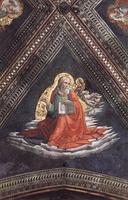
St. Matthew the Evangelist
Domenico Ghirlandaio
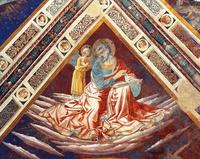
St.Matthew (detail of The Four Evangelists)
Benozzo Gozzoli
Ceiling Frescoes in the Chapel of San Brizio
Luca Signorelli
Martyrs and Saint Virgins
Luca Signorelli
St. Luke
Domenico Ghirlandaio
The Resurrection
Pinturicchio
A Sibyl
Domenico Ghirlandaio
View of the Vaults
Benozzo Gozzoli