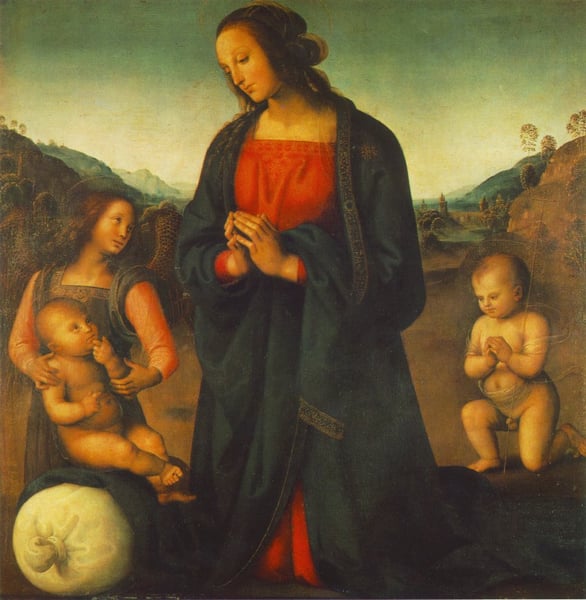
Madonna, an Angel and Little St. John Adoring the Child
Details
Expert analysis of Pietro Perugino’s Madonna, an Angel and Little St. John Adoring the Child
Style: High Renaissance · Genre: religious painting
Expert Art Historical Analysis
Pietro Perugino's Madonna, an Angel and Little St. John Adoring the Child exemplifies the hallmarks of the High Renaissance—a period defined by harmony, idealized beauty, and a serene, balanced composition. As a leading figure of the Umbrian school, Perugino was a pivotal precursor to Raphael, and this work demonstrates the lyrical grace that would deeply influence his pupil’s later Madonnas.
Significance within the High Renaissance Style:
-
Idealized Serenity and Devotional Tone: The painting is a model of the High Renaissance’s pursuit of grazia (grace). The figures are arranged in a calm, pyramidal grouping typical of the era, with the Madonna at the apex, the angel, and the young John the Baptist symmetrically flanking the Christ Child. The tranquil expressions, soft modeling, and gentle gestures create an atmosphere of quiet adoration, emphasizing the divine nature of the scene while making it emotionally accessible to the viewer.
-
Atmospheric Perspective and Landscape: Perugino was a master of spatial clarity. The background—likely a rolling Umbrian landscape with soft, hazy hills and delicate trees—is rendered with sfumato-like transitions. This use of atmospheric perspective not only situates the holy figures in a timeless, idyllic setting but also reflects the High Renaissance fascination with the natural world as a mirror of the divine order.
-
Influence on Raphael: This composition directly prefigures Raphael’s famous Madonna of the Meadow (1505) and other similar works. Perugino’s treatment of the infant Christ and young St. John, their tender interaction, and the Madonna’s downcast, contemplative gaze became a template for devotional intimacy. The angel’s watchful presence adds a celestial dimension that Raphael would later refine with even greater psychological depth.
-
Formal Harmony: The painting’s balanced design—the careful distribution of drapery, the gentle curve of the Madonna’s head, the horizontal line of the landscape—embodies the High Renaissance ideal of concinnitas (harmony of parts). Perugino’s use of oil glaze creates luminous, translucent flesh tones and richly unified color, marking a technical maturity that defines the period.
Conclusion: This work is significant because it crystallizes the transition from Early Renaissance experimentation to the fully realized High Renaissance aesthetic. Perugino’s ability to blend spiritual transcendence with earthly tenderness, while maintaining impeccable compositional order, made him one of the most sought-after artists of his time. The painting stands as a testament to the era’s belief that art could reveal the divine through beauty, balance, and quiet emotion—a legacy that culminates in Raphael’s masterpieces.
Museum / Gallery
Visually similar
20 works with related composition and palette
Virgin with a Child, St. John and an angel (Madonna del Sacco)
Pietro Perugino
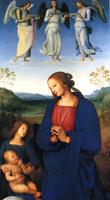
The Virgin and Child with an Angel
Pietro Perugino
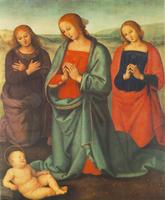
Madonna with saints adoring the child
Pietro Perugino
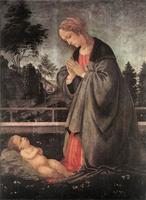
Adoration of the Child
Filippino Lippi
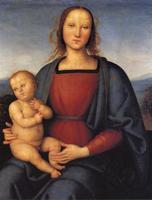
Madonna with Child
Pietro Perugino
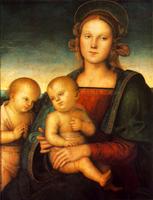
Madonna with Child and Little St. John
Pietro Perugino
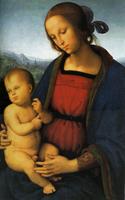
Madonna with Child
Pietro Perugino
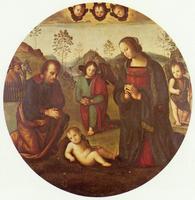
Birth of Christ, Tondo
Pietro Perugino
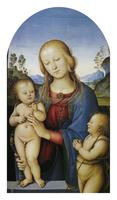
Madonna with Children and St.John
Pietro Perugino
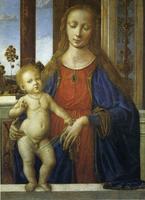
Madonna with Child
Pietro Perugino
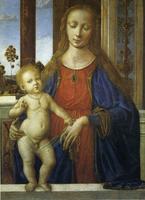
Madonna and Child
Andrea del Verrocchio
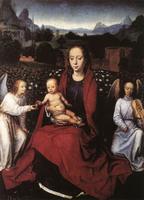
Virgin and Child in a Rose Garden with Two Angels
Hans Memling
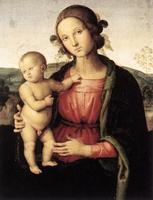
Madonna and Child
Pietro Perugino
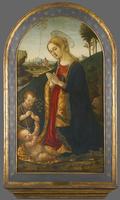
Madonna and Child in a Landscape with the Infant St. John the Baptist
Francesco Botticini
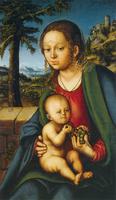
Virgin and Child with a Bunch of Grapes
Lucas Cranach the Elder
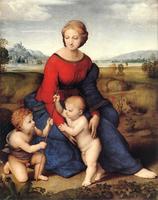
Madonna in the Meadow
Raphael
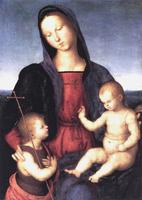
Diotalevi Madonna
Raphael
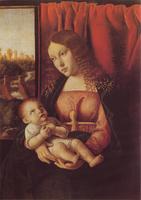
Madonna Con Il Bambino
Bartolomeo Veneto
Madonna and Child with an Angel
Sandro Botticelli
Madonna and Child on a grass bench
Dirk Bouts