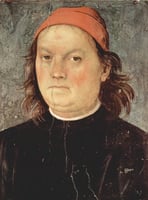

Polyptych Annunziata (St. Helena)
Expert analysis of Pietro Perugino’s Polyptych Annunziata (St. Helena)
Style: Early Renaissance · Genre: religious painting
Expert Analysis: "Polyptych Annunziata (St. Helena)" by Pietro Perugino
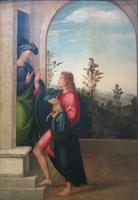
As a work of the Early Renaissance, this religious painting by Pietro Perugino exemplifies the era's shift from medieval formalism toward naturalism, balanced composition, and spiritual serenity. The piece is a polyptych—a multi-panel altarpiece—which was a typical format for devotional works in the 15th century, allowing for complex narrative and hierarchical arrangement of sacred figures.
Significance within the Early Renaissance:
Perugino was a master of the Umbrian school and a direct influence on Raphael. His style is characterized by soft, atmospheric landscapes, delicate figures, and a calm, harmonious arrangement that prioritizes clarity and piety. In this polyptych, the depiction of St. Helena—traditionally associated with the discovery of the True Cross—would have served both as a focus for private devotion and as a public emblem of faith. The composition likely employs Perugino's signature use of linear perspective and balanced symmetry, creating a sense of ordered, divine space.
Why this artwork matters:
- It represents the culmination of Early Renaissance ideals: a fusion of theological narrative with humanist grace, where sacred figures appear both earthly and transcendent.
- Perugino's treatment of the polyptych format—integrating multiple panels into a unified spatial and emotional whole—demonstrates the era's move away from Gothic fragmentation toward Renaissance coherence.
- The work's calm, meditative quality foreshadows the High Renaissance's focus on idealized beauty and serene spirituality, making it a key example of the transition from medieval iconography to modern pictorial sensibility.
Visually similar
20 works with related composition and palette
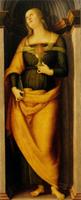
Polyptych Annunziata (St. Illuminata)
Pietro Perugino
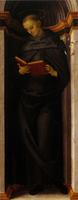
Polyptych Annunziata (St. Philip Benizi)
Pietro Perugino
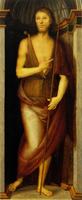
Polyptych Annunziata (John the Baptist)
Pietro Perugino
St. Euphemia
Andrea Mantegna
San Matteo
Domenico Beccafumi
Prophet
Tintoretto
Prophet
Tintoretto
The Sorrows
Albrecht Durer
S. M. Maddalena and S. Caterina D'alexandria
Mariotto Albertinelli
St. Catherine of Siena and St. Lawrence
Domenico Ghirlandaio
St. Stephen the Martyr
Domenico Ghirlandaio
Hope
Piero del Pollaiolo
Altarpiece of St. Augustine - Scene John the Tufer and the St. Augustine
Pietro Perugino
St. John the Baptist and St. Mary Magdalen. Wings of a triptych
Hans Memling
Madonna and Child
Correggio
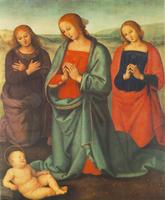
Madonna with saints adoring the child
Pietro Perugino
St. Alberto of Trapani
Filippo Lippi
Saint Catherine of Alexandria
Hans Baldung
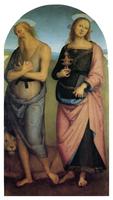
Pala di Sant Agostino (St. Jerome and Santa Maria Magdalena)
Pietro Perugino
Episode from the Genesis
Mariotto Albertinelli