Expert analysis of Bartolome Esteban Murillo’s Jacob's Dream
Style: Baroque · Genre: religious painting
Expert Art Historical Analysis: "Jacob's Dream" by Bartolome Esteban Murillo
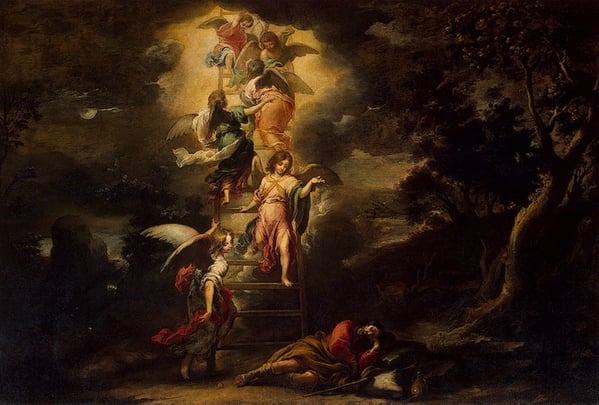
As a premier example of the Spanish Baroque, Murillo’s Jacob’s Dream is significant for its masterful synthesis of naturalism, divine illumination, and emotional accessibility—hallmarks that distinguish his religious oeuvre. Painted in the mid-17th century, the work depicts the biblical patriarch Jacob sleeping on the ground, his head resting on a stone, while a ladder stretches to heaven with angels ascending and descending (Genesis 28:10–22). Murillo transforms this transcendent vision into an intimate, earthly scene, characteristic of the Counter-Reformation’s aim to make sacred stories relatable to the faithful.
Significance within the Baroque Style:
- Tenebrism and Divine Light: Murillo employs a soft, golden chiaroscuro that radiates from the angelic ladder, bathing Jacob’s sleeping figure in a warm, supernatural glow. Unlike the stark tenebrism of Caravaggio or Ribera, Murillo’s handling is gentler, emphasizing grace over drama. The light source appears both celestial and natural, unifying the earthly plane (Jacob) with the heavenly realm—a Baroque device to collapse the boundary between the mundane and the divine.
- Composition and Movement: The diagonal sweep of the ladder and the swirling of angels create a dynamic, spiraling ascent, typical of Baroque dynamism. Yet the composition is balanced by Jacob’s recumbent, diagonally opposite form, anchoring the scene. This tension between stillness and motion mirrors the Baroque fascination with fleeting, dramatic moments.
- Emotive Naturalism: Murillo’s figures are rendered with remarkable softness and human warmth. Jacob’s relaxed pose and vulnerable expression invite empathy, while the angels—childlike and tender—embody Murillo’s signature dulzura (sweetness). This aligns with the Spanish Baroque emphasis on afectos (affective piety), making the miracle feel present and personal.
Significance within Religious Painting:
- Counter-Reformation Accessibility: Painted for a religious audience, the work eschews overt symbolism for a more narrative, approachable treatment. The stone pillow, the ladder, and the glowing angels are immediately legible, allowing viewers to contemplate Jacob’s covenant with God without theological abstraction. Murillo’s choice to depict the angels as playful, almost cherubic beings reflects his role in popularizing a tender, domestic vision of the holy.
- Influence and Legacy: Jacob’s Dream exemplifies Murillo’s mature style, which profoundly influenced later Spanish and Latin American devotional art. His ability to blend realism with ethereal beauty made this work a model for conveying divine presence through human emotion—a defining achievement of the Baroque religious image.
In sum, Murillo’s Jacob’s Dream transcends its biblical source by fusing the theatricality of Baroque art with a gentle, accessible piety. It remains significant as a masterwork of Spanish Golden Age painting, demonstrating how light, naturalism, and sentiment could make the miraculous feel palpably close.
Museum / Gallery
Visually similar
20 works with related composition and palette
Saint Jame’s Vision of the Virgin of the Pillar
Antonio González Velázquez
Le Christ au Mont des Oliviers
Jacob van Schuppen
Cristo En El Jardín De Getsemaní
Sebastiano Conca
Obra Preparatòria De La Conversión De San Pablo
Juan Bautista Maíno
The Virgin of the Apocalypse
Miguel Cabrera
Hagar and the angel
Jean II Restout
The Royal Hunt of Dido and Aeneas
Francesco Solimena
Angel
Vicente López Portaña
Hagar and the Angel
Pieter Lastman
Saint Thecla Liberating the City of Este from the Plague
Giovanni Battista Tiepolo
Allegory of Temperance
Luca Giordano
Angels bearing the instruments of the Passion
Simon Vouet
The Assumption of the Virgin
Luca Giordano
Diana and Endymion
Giambattista Pittoni
Diana and Endymion
Giambattista Pittoni
Saint Bridget Saved from a Shipwreck by the Virgin
Luca Giordano
Baptism of Christ
Jan Brueghel the Younger
The Angel Raphael Takes Leave of Old Tobit and his Son Tobias
Pieter Lastman
Abraham and the Three Angels
Giovanni Domenico Tiepolo
LAnnonciation
Ludovico Carracci