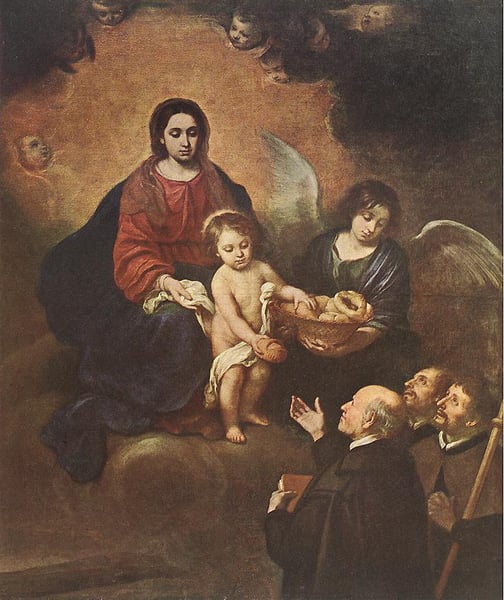
Expert analysis of Bartolome Esteban Murillo’s The Infant Jesus Distributing Bread to Pilgrims
Style: Baroque · Genre: religious painting
Expert Analysis: "The Infant Jesus Distributing Bread to Pilgrims" by Bartolome Esteban Murillo
This work is a quintessential example of Murillo’s mature Baroque style, yet it diverges from the more theatrical, high-contrast drama of contemporaries like Caravaggio or Zurbarán. Instead, Murillo infuses the scene with a gentle, naturalistic tenderness that became his hallmark. The painting’s significance lies in how it humanizes divine subject matter, blending everyday realism with spiritual warmth.
Stylistic Significance within Baroque Art
Murillo’s Baroque is one of soft chiaroscuro and warm, atmospheric light—a style often called estilo vaporoso (vaporous style). Here, the Infant Jesus is not a remote, majestic figure but a playful, compassionate child. The pilgrims, depicted with humble, worn features, receive bread in a gesture that echoes the Eucharist, yet the setting feels domestic and accessible. This fusion of the sacred and the mundane was revolutionary: it made theology intimate for a 17th-century Spanish audience, emphasizing charity and divine generosity over judgment.
Religious and Iconographic Impact
The theme of distributing bread directly references the miracle of the loaves and the Last Supper, but by showing Christ as an infant, Murillo underscores the innocence and purity of divine grace. The pilgrims’ outstretched hands and trusting faces reflect a Counter-Reformation emphasis on piety accessible to all, especially the poor. Murillo’s typical soft, rounded forms and delicate coloring (pinks, blues, and warm ochres) create a serene, almost lullaby-like atmosphere, drawing the viewer into a meditative state.
Why It Matters
This painting exemplifies Murillo’s role as the “painter of the people.” His work in Seville’s charitable institutions informed his compassionate depiction of poverty and faith. The Infant Jesus Distributing Bread to Pilgrims stands as a masterful synthesis of Baroque naturalism and Counter-Reformation spirituality, offering a vision of Christianity that is both humanly tender and theologically profound. It remains a key work for understanding how Baroque art could speak to the heart as well as the eye.
Museum / Gallery
Visually similar
20 works with related composition and palette
The Vision of St. Francis
Lazzaro Baldi
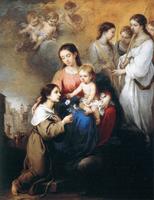
The Virgin and Child with St. Rosalina
Bartolome Esteban Murillo
Sacra Conversazione
Antonio González Velázquez
The Virgin and Child Appearing to Saint Francis of Assisi
Luca Giordano
The Mystic Marriage of Saint Catherine
Bartolome Esteban Murillo
The Vision of St Anthony
Anthony van Dyck
The Madonna and Child in Glory with Saints Ignatius of Loyola and Xavier
Pacecco de Rosa
Coronation of the Virgin with Saints Joseph and Francis of Assisi
Giulio Cesare Procaccini
Saint Anthony of Padua holding the Christ Child and surrounded by angels
Ludovico Carracci
Die Jungfrau Präsentiert Das Christuskind Dem Heiligen Franziskus
Juan van der Hamen
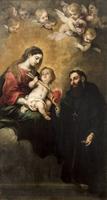
St. Augustine with the Virgin and Child
Bartolome Esteban Murillo
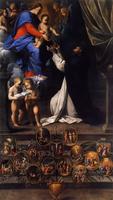
Rosary Madonna
Guido Reni
The Madonna and Child with Saint Martina
Lazzaro Baldi
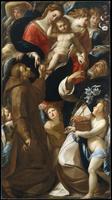
Madonna and Child with Saints Francis and Dominic and Angels
Giulio Cesare Procaccini
Vision of St. Anthony of Padua
Alonzo Cano
The Holy Family (The Seville Virgin)
Bartolome Esteban Murillo
Holy Family with Saints
Jacopo Pontormo
Nossa Senhora do Carmo e São Simão Stock
Mestre Ataíde
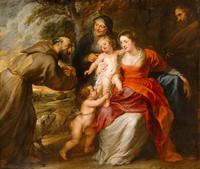
The Holy Family with Saints Francis and Anne and the Infant Saint John the Baptist
Peter Paul Rubens
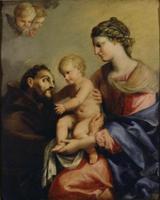
L'extase De St François
Pompeo Batoni