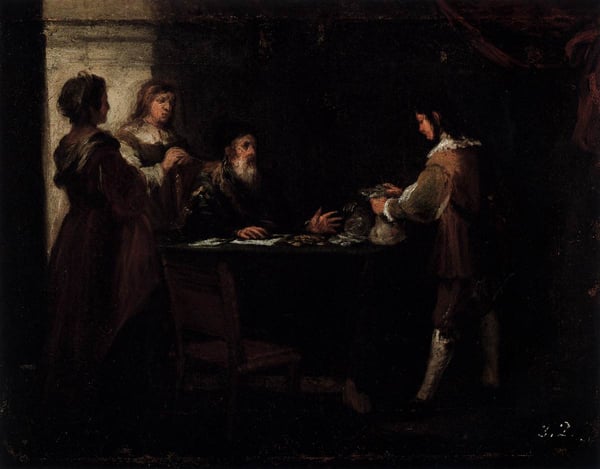
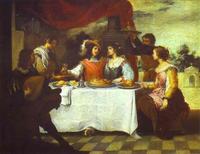
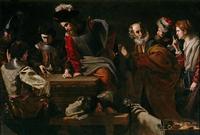
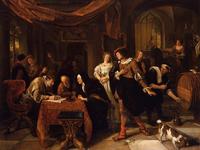
Bartolomé Esteban Murillo’s The Prodigal Son Receives His Rightful Inheritance (c. 1660s) is a masterful example of Baroque religious painting that elevates a familiar parable into a deeply human moment. Created during Murillo’s mature period in Seville, the work belongs to a series tracing the Prodigal Son’s journey—a narrative of sin, repentance, and forgiveness. Here, Murillo captures the pivotal scene before the son’s departure, focusing not on biblical grandeur but on intimate psychological drama.
What makes this artwork significant is its distinctively tender, naturalistic treatment of a moral lesson. Unlike the dramatic chiaroscuro and intense emotion of many Baroque contemporaries, Murillo employs a softer, more luminous palette and a gentle, almost domestic realism. The father’s handing over of the inheritance is rendered with quiet dignity; the son’s posture suggests eagerness mingled with deference, while the father’s gesture conveys reluctant generosity. Subtle details—the worn fabrics, the subdued expressions, the warm, golden light—ground the sacred narrative in everyday life, making the spiritual message accessible and empathetic.
Murillo’s artistic achievement lies in his synthesis of Baroque theatricality with a compassionate humanism. He avoids melodrama, instead using composition and lighting to direct the viewer’s gaze to the exchange of coins, symbolizing both worldly desire and the paternal love that will later welcome the repentant son. This focus on familial emotion and moral complexity marks Murillo as a distinct voice in Spanish Baroque painting, one who prioritized the heart of the story over its spectacle. The painting endures as a seminal work that reimagines religious art as a vehicle for universal human experience.