Camille Corot sanatçısının Children beside a brook in the countryside, Lormes eseri hakkında uzman analizi
Tarz: Realism · Tür: genre painting
Expert Analysis: "Children beside a brook in the countryside, Lormes" by Camille Corot
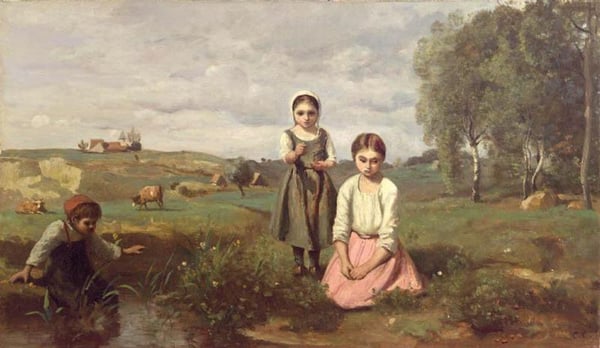
Camille Corot’s Children beside a brook in the countryside, Lormes exemplifies the artist’s unique position within the Realist movement—a painter who fused the structured observation of nature with a lyrical, almost dreamlike sensitivity. Although Corot is celebrated foremost as a landscape painter, this work belongs to the genre painting tradition, depicting everyday rural life with a quiet, unposed dignity.
Significance within Realism:
While many Realists (e.g., Courbet) emphasized the gritty, laborious aspects of peasant existence, Corot’s realism is gentler, focusing on the harmonious coexistence of humans and the natural world. Here, the children are not idealized or allegorical; they are simply figures at rest beside a brook in the village of Lormes. Their presence is absorbed into the landscape—the soft light filtering through trees, the reflective surface of the water—rather than dominating it. This approach reinforces Corot’s belief that humanity is part of nature’s continuum, not separate from it.
Technical and Stylistic hallmarks:
- Plein-air naturalism: Corot painted many studies outdoors, and this work likely retains that freshness. The loose, feathery brushwork in the foliage and the subtle, silvery tonality are signatures of his mature style. He avoids harsh outlines; instead, forms emerge from gradations of light and shadow.
- Compositional balance: The children are placed slightly off-center, with the brook leading the viewer’s eye into the distance. This creates a serene, contemplative rhythm—a hallmark of Corot’s “quiet landscapes” that later influenced the Barbizon school and Impressionists like Monet.
- Atmospheric unity: Unlike the crisp detail of Neoclassicism, Corot bathes the scene in a unifying haze. The figures’ clothing (likely in earth tones) blends with the surrounding greenery, emphasizing the oneness of the scene rather than individual anecdote.
Why this work matters:
It captures a transitional moment in art history: the shift from idealized, historical genre paintings to a more authentic, momentary observation of life. Corot’s ability to elevate a simple rural scene—children playing by a stream—into a meditation on light, stillness, and human connection to place is what makes this painting significant. It stands as a testament to Realism’s breadth, proving that truthful depiction need not abandon poetic tenderness.
Museum / Gallery
Görsel olarak benzer
İlişkili kompozisyon ve renk paletine sahip 20 eser
At the fountain
Léon Augustin Lhermitte
Two Cowherds in a Meadow by the Water
Camille Corot
Picking flowers
Carl von Bergen
Drawing water
Léon Augustin Lhermitte
Love tokens
Jules Breton
The little fountain (July 1876)
Léon Augustin Lhermitte
Break For Refreshment, Harvest Time
John Absolon
Young peasant woman with her daughters
Carl von Bergen
Girl by a stream, Flanders
Daniel Ridgway Knight
Two young woman picking grapes (Study for „The vintage at Château Lagrange“)
Jules Breton
In the spring meadow
Ludwig Knaus
Young Peasant Woman Playing with Cockchafers
Jules Breton
Shadow and Sunlight
Julien Dupré
The friends
Jules Breton
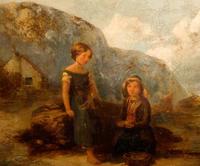
Children Gathering Seaweed
William Collins
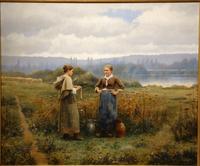
The meeting
Daniel Ridgway Knight
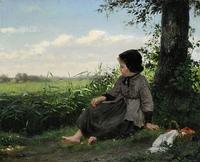
Girl on a meadow
Paul Jamin
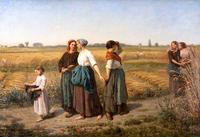
The Reapers
Jules Breton
A Spring by the Sea
Jules Breton
The Days Catch
Daniel Ridgway Knight