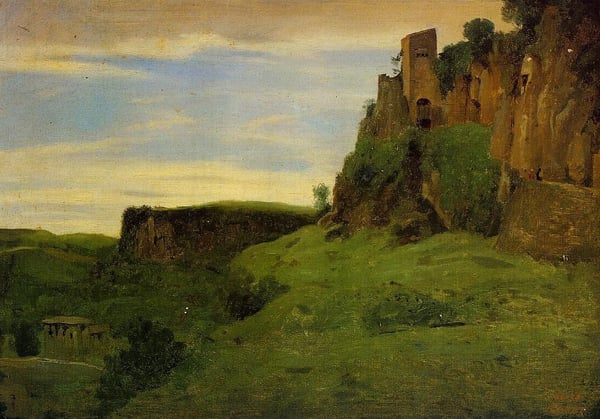
Civita Castellana Buildings High in the Rocks (La Porta San Salvatore)
Details
Expert analysis of Camille Corot’s Civita Castellana Buildings High in the Rocks (La Porta San Salvatore)
Style: Realism · Genre: landscape
Expert Analysis: "Civita Castellana Buildings High in the Rocks (La Porta San Salvatore)" by Camille Corot
Camille Corot’s Civita Castellana Buildings High in the Rocks (also known as La Porta San Salvatore) is a masterful landscape that exemplifies the transition from Neoclassical idealism to the naturalistic observation that defines Realism. Painted during Corot’s Italian sojourns, the work depicts the ancient hill town of Civita Castellana, its buildings seemingly fused with the rugged rock formations.
Significance within Realism and Corot’s Oeuvre:
-
Truth to Nature with Poetic Balance – Corot avoids the theatricality of earlier Romantic landscapes. Instead, he records the actual geological strata and weathered architecture with precise, unembellished brushwork. The title itself emphasizes the vernacular structures “high in the rocks,” grounding the scene in a specific locale rather than an imagined ideal.
-
Integration of Architecture and Landscape – The buildings are not mere accessories but organic extensions of the cliff face. Corot’s subtle tonal harmonies—muted earth tones, soft grays, and gentle greens—unify the man-made and natural forms, anticipating the Barbizon school’s reverence for the everyday countryside.
-
Light and Atmosphere – Even within a Realist framework, Corot’s handling of light is luminous and nuanced. The rocky outcrops are modeled with soft chiaroscuro, while the sky retains a silvery, atmospheric quality that would later influence Impressionist treatments of plein-air light.
-
Historical and Geographical Truth – Civita Castellana (ancient Falerii) held archaeological significance. By capturing its actual appearance—including the gate of San Salvatore—Corot contributes to the 19th-century documentary impulse, recording Italy’s vernacular architecture before modernist transformations.
-
Precursor to Modern Landscape – This work bridges Corot’s early Neoclassical precision and his later, freer lyricism. It demonstrates his ability to find structural dignity in ordinary subjects, a core tenet of Realism that paved the way for Courbet’s and Daubigny’s unidealized depictions of rural life.
Conclusion:
“Civita Castellana Buildings High in the Rocks” is significant as a quintessential Realist landscape that balances topographic accuracy with a serene, almost meditative composition. Corot’s subtlety—his refusal to dramatize or sentimentalize—elevates a humble hill town into a timeless study of nature and human habitation in dialogue.
Museum / Gallery
Visually similar
20 works with related composition and palette
Town in Auvergne
Theodore Rousseau
View of Civita Castellana
Daniël Dupré
The Source at Ornans
Gustave Courbet
Two Italians, an Old Man and a Young Boy
Camille Corot
Malhec rocks in the Valley of Saint-Vincent
Theodore Rousseau
Catskill Scenery
Thomas Cole
Convent of San-Cosimato and Part of the Claudian Aqueduct near Vicovaro in the Roman Campagna
Joseph Wright
Arroyo de Tlaxcala
Jose Maria Velasco
A view of the Roman Campagna from Tivoli
Claude Lorrain
View of Delphi
Claude Lorrain
View of Delphi with a Procession
Claude Lorrain
Paysage rocheux avec une rivière
Louis Gauffier
Evening mood on the Rhine (Koblenz)
Albert Flamm
Paysage Guyere
Gustave Courbet
Paisaje
Luis Rigalt
Cliffs near Ornans
Gustave Courbet
Fantasy Mountain Scene
Carl Blechen
The Tower in the Trees
Camille Corot
The Cascatelli, Tivoli, Looking Towards Rome (View of Rome from Tivoli)
Thomas Cole
Moonlight
Thomas Cole