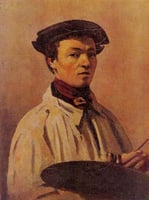
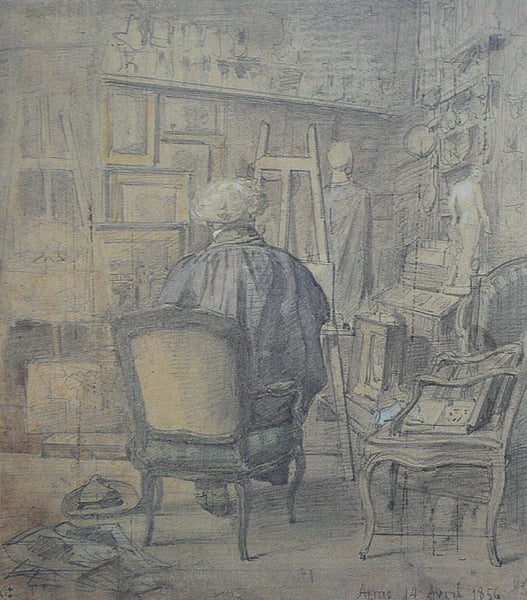
Corot in the Studio of Constant Dutilleux
Dettagli
Analisi esperta di Corot in the Studio of Constant Dutilleux di Camille Corot
Stile: Realism · Genere: self-portrait
Expert Analysis: "Corot in the Studio of Constant Dutilleux" (Camille Corot)
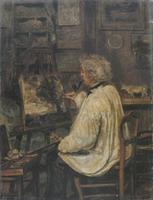
This self-portrait occupies a unique intersection within the Realist movement, merging personal introspection with a collaborative artistic environment. Painted in the studio of fellow artist Constant Dutilleux, the work transcends a simple likeness to become a document of artistic camaraderie and influence. Corot, primarily known for his lyrical landscapes, here turns the Realist lens on himself—but the setting is equally telling.
Significance within Realism and the Self-Portrait Genre:
-
Realism’s Emphasis on Truthful Setting: Rather than placing himself in an idealized or classical environment, Corot anchors the portrait in a working studio—cluttered, atmospheric, and unadorned. This aligns with Realism’s commitment to depicting ordinary spaces and authentic moments, rejecting romanticized backdrops.
-
Interplay of Artist and Environment: The inclusion of Dutilleux’s studio signals the importance of artistic exchange. Dutilleux was a close friend and technical collaborator, and Corot’s choice to depict himself in another’s workspace shows a deliberate blurring of individual identity and collective practice—a subtle commentary on the social fabric of Realist creation.
-
Self-Portrait as Document: Unlike the dramatic self-portraits of earlier Romantic era, Corot’s approach is understated. He presents himself not as a solitary genius but as a part of a community. The realism of the scene—the light, the tools, the unposed expression—elevates the work from mere likeness to a historical record of an artist in his natural habitat.
-
Stylistic Continuity: True to Corot’s poetic Realism, the painting balances careful observation with soft, tonal harmonies. The brushwork and muted palette reflect his signature sensitivity to light and atmosphere, even in an intimate interior. This bridges his landscape practice with his figure work, demonstrating that Realism could be both personal and universal.
In summary, the artwork is significant because it uses the self-portrait genre not for self-mythologizing, but to document the real, relational context of artistic life in mid-19th-century France—a quiet yet powerful assertion of Realist principles.
Visivamente simili
20 opere con composizione e palette affini
Study of an artist in his studio
Henry Mosler
Self-portrait in the studio
Umberto Veruda
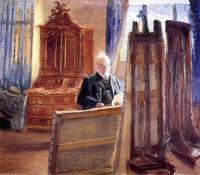
Michael Ancher Painting in His Studio
Anna Ancher
Les Hommes D'aujourd'hui, N°366 (1890), détail De La Couverture
Lucien Pissarro
Interieur
Bela Czobel
The Artist's Studio
Achille Glisenti
Untitled
Omer Mujadžić
Thomas Faed, 1825 - 1900. Artist (in his studio)
John Ballantyne
Miss Bertha Salter, Singer from North Devon
John Ballantyne
Portrait of Fattori in his studio
Giovanni Boldini
Portrait of Jacob's son
Abraham van Strij
The artist in his studio
Clément-Auguste Andrieux
In the artist studio (Self-portrait)
Clément-Auguste Andrieux
The sisters Schwartz
Anders Zorn
Self portrait of painter with his model
Yiannis Tsaroychis
Self Portrait in the Studio
Carl Larsson
Corot Painting in the Studio of his Friend, Painter Constant Dutilleux
Camille Corot
William Holman Hunt
John Ballantyne
The artist and his model
Alfred Dehodencq
Efry József, Műteremben 1910
Egry József