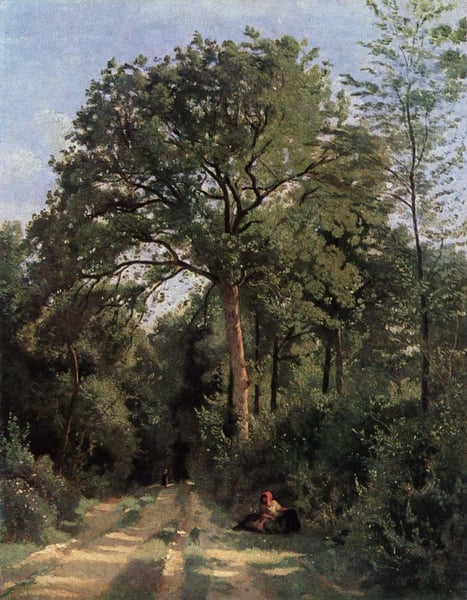
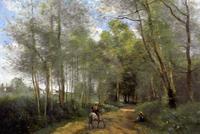
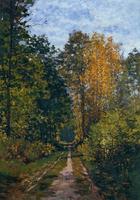
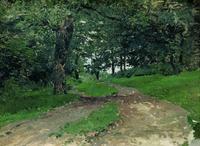
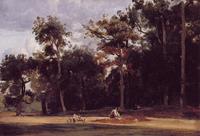
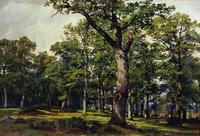
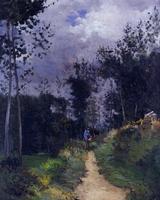
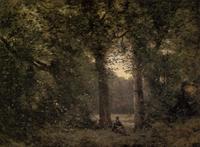
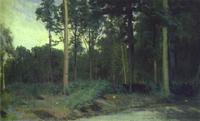
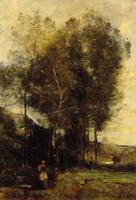
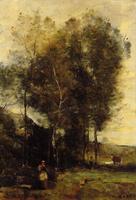
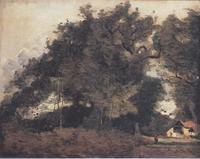
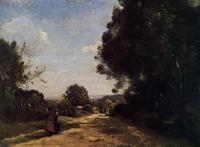
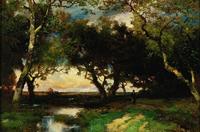
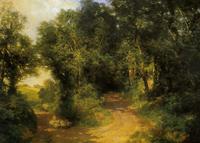
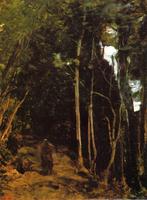
Camille Corot's "Forest Entrance at Ville d'Avray" is a defining work of the Realist movement, notable for its quiet synthesis of observed nature and lyrical atmosphere. Painted in the forest surrounding his beloved Ville d'Avray, the work exemplifies Corot’s signature approach: a subdued, silvery palette that captures the soft, diffused light filtering through trees. Rather than the dramatic grandeur of Romantic landscapes or the clinical precision of earlier Neoclassicism, Corot focuses on a humble, unheroic forest edge, rendering the scene with a delicate touch that anticipates the Impressionists' concern for transient light effects.
The painting’s significance lies in its balance of structural clarity and atmospheric softness—a hallmark of Corot’s mature Realism. By choosing an unremarkable entrance to the woods, he elevates the everyday landscape to a subject worthy of serious artistic study, aligning with Realism’s commitment to truthful, unidealized depiction. At the same time, his subtle play of dappled shadows and muted greens imparts a poetic, almost reverent stillness, demonstrating that Realism need not sacrifice emotion for accuracy. This fusion of direct observation with tonal harmony made Corot a crucial bridge between the Barbizon school's naturalism and the later Impressionist revolution, securing "Forest Entrance at Ville d'Avray" as a landmark of mid-19th-century landscape painting.