Analisi esperta di Houses near Orleans di Camille Corot
Stile: Realism · Genere: landscape
Expert Analysis: "Houses near Orleans" by Camille Corot
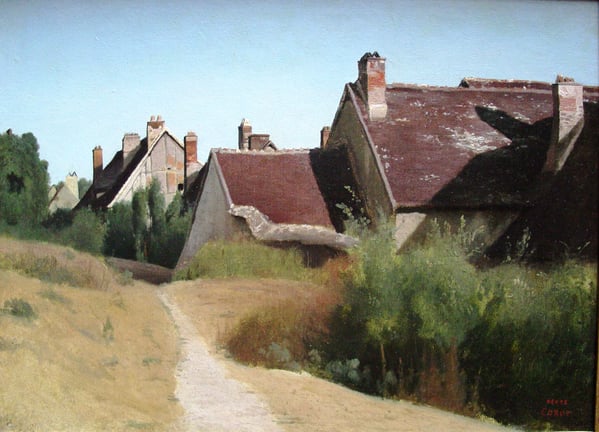
Camille Corot’s Houses near Orleans stands as a pivotal work within the Realist landscape tradition, bridging the poetic classicism of his early career with the direct, observational approach that would profoundly influence the Barbizon School and later Impressionists. Painted during a period when Corot increasingly turned to plein air studies, this work exemplifies his commitment to capturing the unidealized essence of rural France.
Stylistic Significance:
Unlike his earlier mythological landscapes, Houses near Orleans strips away narrative drama in favor of truthful, everyday simplicity. The composition is deliberately unromantic: a cluster of modest farm buildings, perhaps bathed in the soft, gray light of the Île-de-France, set against a low horizon and a placid sky. Corot’s brushwork combines broad, atmospheric washes (seen in the sky and foliage) with structurally precise touches (the roofs and walls), creating a sense of natural harmony without excessive detail. This balance between valeur (tonal unity) and tactile realism was revolutionary—it rejected the theatricality of academic painting while retaining a sense of poetic tranquility.
Realist Innovation:
The painting’s significance lies in its democratic subject matter. Corot elevated a humble, unremarkable locale—likely a farmstead along the Loire River—into a subject worthy of serious artistic study. This aligned with the Realist credo of depicting contemporary life as it was, not as idealized. The muted palette of earthy ochres, soft greens, and silvery blues reinforces the quotidian dignity of the scene. There is no grand moral message; only the quiet observation of light filtering through clouds and the sturdy geometry of rural architecture.
Legacy and Influence:
Houses near Orleans exemplifies Corot’s mature “symphonic” phase, where he synthesized plein air spontaneity with studio refinement. His ability to infuse a common landscape with lyrical stillness directly inspired later Realists like Jean-François Millet (in his pastoral scenes) and paved the way for the Impressionists’ focus on transient light. Moreover, Corot’s restrained tonality—achieved through thin glazes and soft edges—made him a touchstone for painters seeking to capture atmospheric mood without sentimentality.
In sum: This work is a landmark of Realist landscape painting because it transforms the ordinary into the timeless, celebrating the unassuming beauty of rural France through a masterful blend of observation, restraint, and quiet poetry. Corot’s Houses near Orleans reminds us that true realism is not documentation, but a vision that finds profound significance in the simplest of places.
Visivamente simili
20 opere con composizione e palette affini
The Tumbledown Cottage near Osny
Camille Pissarro
Osny, the gate of Busagny farm
Paul Gauguin
Rue a Ennery
Gustave Loiseau
L'Hermitage at Pontoise
Camille Pissarro
Les Fleurs de l'été - champ à Slack
Maurice Boitel
Morvan, The Little Mill
Camille Corot
Jacob Coin de village
Camille Pissarro
Village Church
Camille Pissarro
Village Corner
Camille Pissarro
Entering a Village
Camille Pissarro
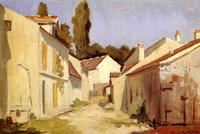
Le Clos des Abbesses
Gustave Caillebotte
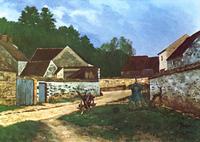
Dorfstrasse in Marlotte
Alfred Sisley
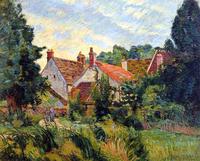
Epinay-sur-Orge
Armand Guillaumin
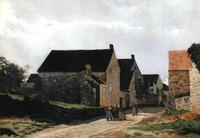
Street of Marlotte (also known as Women Going to the Woods)
Alfred Sisley
A part of Jallais, Pontoise
Camille Pissarro
Meet
Henri Martin
Essoyes Landscape
Pierre-Auguste Renoir
The Inn at Montigny les Cormeilles
Camille Corot
La Maison De Mimi Pinson À Montmartre, Paris
Pierre-Jacques Pelletier
View of l'Hermitage at Pontoise
Camille Pissarro