Expertenanalyse zu Camille Corots Italian Monk Reading
Stil: Realism · Genre: portrait
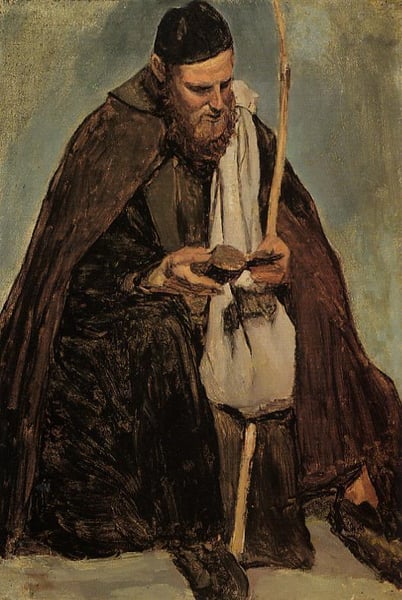
Expert Analysis: Italian Monk Reading by Camille Corot (c. 1826–1828)
Though Camille Corot is celebrated primarily as a pioneer of landscape painting and a precursor to Impressionism, his portraits and figure studies—especially those executed during his early travels in Italy—reveal a master of quiet, contemplative realism. Italian Monk Reading belongs to this formative period, when Corot sojourned in Rome and its environs, absorbing the Italianate light and the unpretentious dignity of everyday life.
Stylistic and Formal Significance
Painted in Corot’s hallmark “veiled” style, the work merges the precision of Realism with a soft, atmospheric handling that prefigures his later "silver-gray" tonalism. The monk is shown in profile, absorbed in a book, his cowled head and simple habit rendered with broad, restrained brushstrokes. Corot eschews dramatic chiaroscuro in favor of a diffused, gentle illumination that models the figure through subtle shifts of warm ochre, umber, and muted white. The background is deliberately vague—a wash of earthy brown and green—focusing all attention on the act of reading itself.
Significance within Realism and Corot’s Oeuvre
This portrait exemplifies Realism’s turn toward the ordinary and the authentic, but with a poetic sensibility unique to Corot. Unlike the social critique of Courbet or the documentary exactitude of the plein-air realists, Corot’s realism is meditative. The monk is not a symbol of piety or asceticism; he is simply a man in a private moment of study. This quiet democracy of subject matter—the elevation of a humble, anonymous figure—was radical for its time, challenging academic portraiture’s emphasis on status and narrative.
Moreover, Italian Monk Reading demonstrates Corot’s skill in capturing the essence of a person without anecdote or moralizing. The work’s subdued palette and loose handling influenced later artists like the Barbizon school and, eventually, the Impressionists, who admired Corot’s ability to suggest form through tone and light.
Historical and Artistic Context
Painted during Corot’s first Italian journey (1825–1828), the work reflects his immersion in the countryside and monasteries around Rome. The subject—a Capuchin or Benedictine monk—was likely a local figure he encountered in the hills of Tivoli or the Roman Campagna. The painting stands as a document of Corot’s transition from studio-classical training to the direct observation that would define his mature style. It is also a rare surviving example of his early figure painting, most of which were lost or destroyed.
Legacy
While Italian Monk Reading is less famous than Corot’s landscapes like The Bridge at Narni or Souvenir of Mortefontaine, it is arguably more intimate—a key to understanding how Corot’s realism derived not from exterior facts but from an inner quietude. The work anticipates the psychological depth of later realist portraiture by Manet and Degas, who borrowed Corot’s subtle modeling and restrained color. In its simplicity and humanity, this painting reminds us that Realism, at its finest, is not a mirror held up to the world, but a window into a single, timeless moment.
Museum / Gallery
Visuell ähnlich
20 Werke mit ähnlicher Komposition und Farbpalette
Kneeling beggar
Vasily Surikov
Blackbearded old man
Vasily Surikov
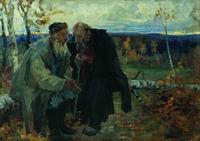
The old men
Andrei Ryabushkin
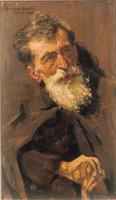
The poor man
Amedeo Bocchi
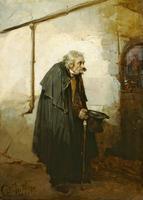
A tribute to the Madonna
Domenico Induno
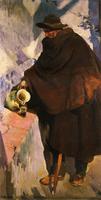
Elderly Castellano Pouring Wine
Joaquín Sorolla
Seated Christ
Vasily Polenov
Moses meets in the desert his brother Aaron, who came towards him at the behest of God (Exodus, IV, 27-28)
Marc Chagall
Portrait of a Peasant
Ilya Repin
Seller of icons
Ivan Tvorozhnikov
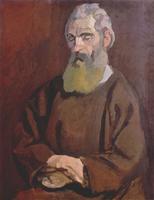
Meditating Monk
Henri Matisse
Hryhoriy Varsava Skovoroda
Mykhailo Vainshtein
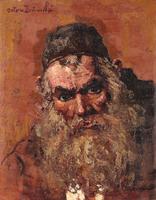
Jewish Portrait
Octav Bancila
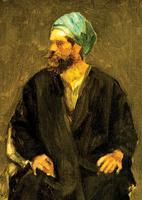
Portrait of a Man
Ivan Mrkviсka
Blind Beggar
Ralph Hedley
Monk - Tax Collector in the Temple
Konstantin Makovsky
Ancião com muleta
Lasar Segall
The pastor
Ferdinand Hodler
Abbess
Boris Kustodiev
Saint Felix Of Cantalice
Peter Paul Rubens