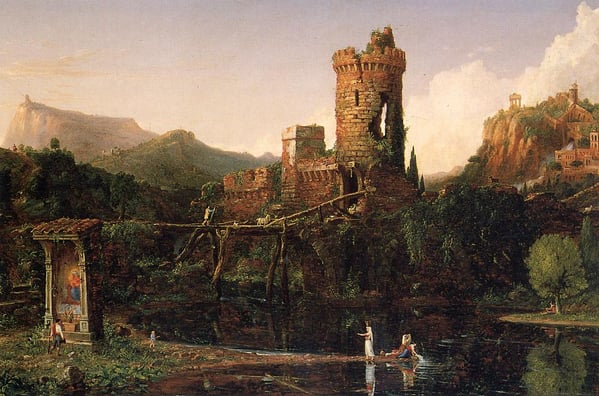
As an expert art historian, I will provide an analysis of Landscape Composition Italian Scenery by Camille Corot based solely on the supplied structured facts: the artwork is a landscape within the Romantic style.
Within the Romantic movement, landscape painting was elevated from mere topographical record to a vehicle for emotion, mood, and the sublime. Corot’s Landscape Composition Italian Scenery is significant precisely because it embodies this Romantic ideal through its choice of subject. The "Italian Scenery" is not a neutral view but a composition—a deliberate arrangement of natural elements to evoke a sense of harmony and poetic grandeur. In Romanticism, Italy was often idealized as a land of timeless beauty, ancient history, and luminous atmosphere. Corot captures this by balancing the observed specifics of the terrain with a soft, almost lyrical treatment of light and space.
The work’s significance lies in how it reconciles two key Romantic impulses: a deep reverence for the raw power and beauty of nature, and a subjective, emotional response to that landscape. Rather than depicting a dramatic, stormy scene typical of some Romantic works, Corot’s composition suggests a quieter, meditative awe. The "Italian Scenery" becomes a locus for nostalgia and transcendence, making the viewer feel the weight of history and the serenity of the natural world. This approach—infusing a classical landscape with a Romantic sensibility—marks Corot’s contribution to the period, showing how the genre could express intimate feeling without sacrificing structural clarity.