Экспертный разбор работы «Lonesome Valley» художника Camille Corot
Стиль: Realism · Жанр: landscape
Expert Analysis: "Lonesome Valley" by Camille Corot
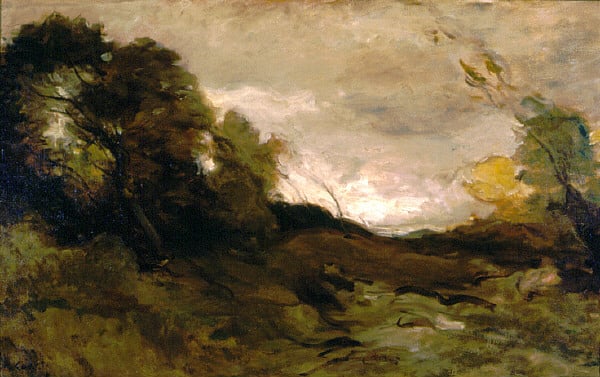
Camille Corot’s "Lonesome Valley" stands as a quintessential example of Realist landscape painting, yet it also reveals the artist’s unique ability to transcend strict documentary observation through poetic mood and tonal harmony. Created during Corot’s mature period, the work embodies the core tenets of Realism—direct study of nature, rejection of idealized composition, and a focus on atmospheric truth—while simultaneously foreshadowing the tonal explorations of the Barbizon school and the later Impressionists.
What makes the work significant within Realism:
- Balancing observation with emotion – Unlike earlier Realists who sometimes emphasized raw, unvarnished nature, Corot infuses "Lonesome Valley" with a subdued, elegiac stillness. The title itself invokes solitude, and Corot achieves this through a muted palette of silvery greens, soft grays, and cool earth tones, creating a veiled, almost silvered light that suggests a specific time of day or weather condition. This attention to transient atmospheric effects was a radical step toward the Impressionist interest in shifting light, yet Corot’s handling remains firmly grounded in the Realist commitment to observed fact.
- Structural simplicity and spatial depth – The composition avoids dramatic vistas or picturesque framing. Instead, a gently winding valley recedes into a hazy horizon, with trees and hills forming soft, layered planes. Corot’s brushwork is both precise and airy—detail is suggested rather than rendered, allowing the eye to sense the texture of foliage and earth without losing the overall unity of the scene. This economy of means became a hallmark of Realist landscape, privileging the artist’s direct encounter with the motif over academic convention.
- Influence on subsequent movements – "Lonesome Valley" exemplifies Corot’s role as a bridge between Neoclassical structure and modern naturalism. His ability to capture the “lonesome” quality of a real place—its stillness, its light, its unspoken narrative—inspired the Barbizon painters (Rousseau, Daubigny) who sought similar intimacy with nature. Moreover, his soft, blurred distances and subtle tonal gradations directly influenced the young Monet and Pissarro, making this work a key document in the evolution from Realism to plein-air Impressionism.
In essence, "Lonesome Valley" is significant because it demonstrates that Realism need not be prosaic. Corot proves that a faithful rendering of a landscape can simultaneously evoke profound emotional resonance—a quiet, meditative encounter with the natural world that remains one of the enduring achievements of 19th-century painting.
Museum / Gallery
Визуально похожие
20 работ с близкой композицией и палитрой
Autumn Landscape
Robert Julian Onderdonk
After the Rain
Granville Redmond
Hamlet and the Gravedigger
Camille Corot
Peasant Girl near a Cabin
Camille Corot
Evening Distant Tower
Camille Corot
The Rocky Stream
Camille Corot
Pond at Sunset
Eugene Boudin
Twisted Trees on a Ridge (Sunset)
Camille Corot
Landscape
Armando Montaner Valdueza
Cincinnati Landscape
John Henry Twachtman
Pond with Dog
Camille Corot
Common with Stormy Sunset
Narcisse-Virgilio Diaz
Landscape
Paul Trouillebert
On The Farm
Constant Troyon
A Road through the Trees
Camille Corot
Banks of the River
Pierre-Auguste Renoir
Landscape
Robert Julian Onderdonk
The Pond
Albert Pinkham Ryder
Day's Dying Glow
Joseph Farquharson
Summer Twilight
Edward Mitchell Bannister