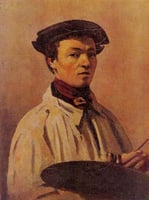
Analisi esperta di Portrait of a Gentleman di Camille Corot
Stile: Realism · Genere: portrait
Expert Analysis: Portrait of a Gentleman by Camille Corot (Realism, Portrait)
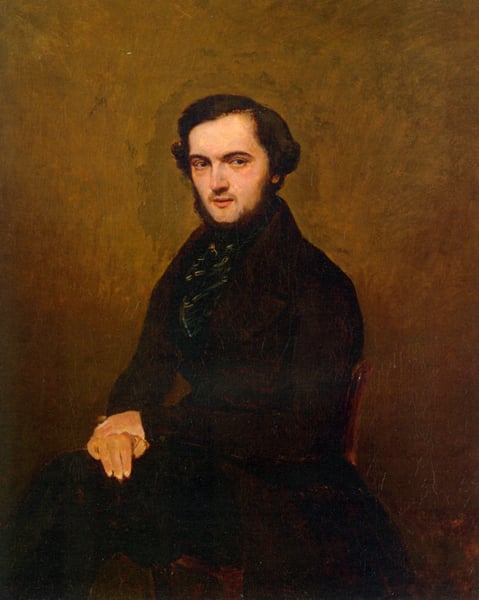
Camille Corot is best known for his poetic landscapes that bridge the Romantic and Realist traditions, but his portraits are a quietly revolutionary aspect of his oeuvre. Portrait of a Gentleman exemplifies Corot's distinctive contribution to Realist portraiture: a fusion of precise observation with an almost atmospheric tenderness.
Stylistic Significance
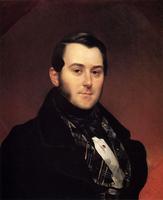
Unlike the dramatic chiaroscuro or idealized features typical of academic portraiture, Corot renders his subject with a subdued, naturalistic palette—soft grays, browns, and muted whites—that avoids theatricality. The sitter’s face is modeled with gentle gradations of light, not harsh contours, allowing the personality to emerge through subtle shifts in shadow. This approach aligns with Realism’s core tenet: the unembellished truth of the subject. Yet Corot’s handling is never dryly documentary; his brushwork retains a painterly softness that evokes the transient effects of atmosphere, a hallmark of his landscape work.
Psychological Depth
The gentleman’s direct, contemplative gaze and relaxed posture suggest a quiet dignity rather than aristocratic hauteur. Corot forgoes elaborate props or symbolic attributes, focusing solely on the sitter’s interior life. The plain background—a muted, neutral tone—heightens this intimacy, stripping away any narrative distraction. The result is a portrait that feels less like a public record and more like a private moment, capturing the unguarded humanity that Realism prized.
Historical Context
At the time (circa 1850s–1860s), Corot was often dismissed as a mere landscape specialist. Yet his portraits, though few, reveal his mastery of tonal harmony and psychological observation—skills that influenced later Realists and even early Impressionists. Portrait of a Gentleman demonstrates that for Corot, “truth” in portraiture meant not only accurate likeness but also an empathetic rendering of presence, making the sitter both specific and universal.
Conclusion
This work is significant because it challenges the boundaries of Realism: it is objectively faithful yet deeply lyrical. Corot proves that realism need not be cold, and that a portrait’s power lies in its ability to reveal character through the subtlest modulation of light and shadow. Portrait of a Gentleman stands as a testament to the artist’s belief that even the most unassuming subject can carry profound artistic and emotional weight.
Museum / Gallery
Visivamente simili
20 opere con composizione e palette affini
Portrait of a man
Jean-Francois Millet
Alexandre Stieglits
Charles de Steuben
Erastus Torrey
Samuel Morse
John Fitzgibbon (1792–1851), 2nd Earl of Clare, KP, GCH, PC
John Jackson
Portrait of François Gabriel "Valcour" Aimé
Jacques Amans
Portrait of a Gentleman
Leonardo Alenza
John Frederick Campbell
Thomas Lawrence
Portrait of a Husband (Two portraits of husband and wife)
Alexander Clarot
Alexander Smith, Poet and Writer
James Archer
Clarkson Stanfield
John Simpson
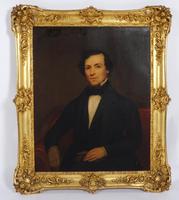
Portrait of a Distiguished Gentleman
Bass Otis
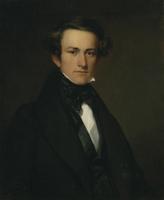
Portrait of John W. Casilear
Asher Brown Durand
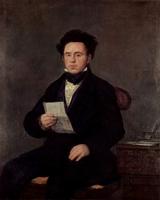
Juan Bautista de Muguiro
Francisco Goya
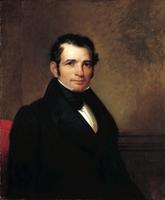
Portrait of Luman Reed
Asher Brown Durand
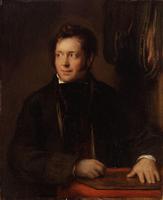
Abraham Raimbach
David Wilkie
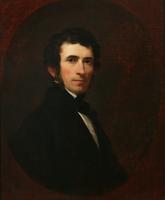
Self-portrait
Asher Brown Durand
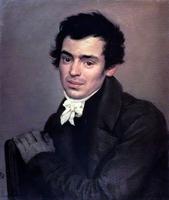
Portrait of the Architect K. A. Ton
Karl Bryullov
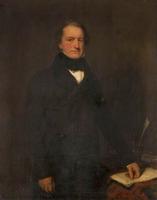
John T. Alston (1780–1857), Provost of Glasgow (1820–1821)
John Graham-Gilbert
Portrait of I. A. Beck
Karl Bryullov
The Right Honourable William Saunders Sebright Lascelles (1798–1851), PC
John Jackson