Expertenanalyse zu Camille Corots Smyrne Bornabat
Stil: Realism · Genre: landscape
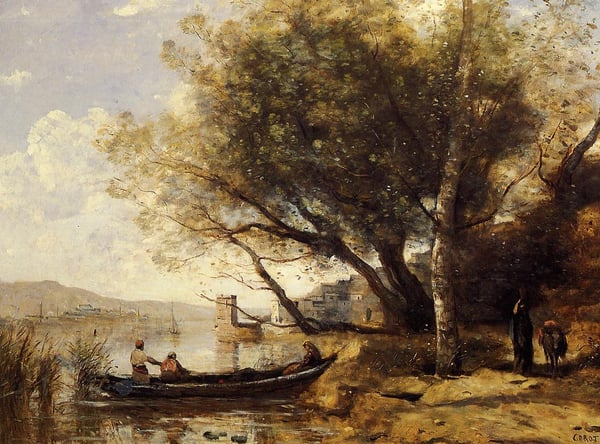
Expert Analysis: Smyrne Bornabat (c. 1840s) by Camille Corot
Style/Period Context:
This work exemplifies the Realist landscape tradition, a shift away from the idealized, heroic landscapes of Neoclassicism and toward a direct, unembellished observation of nature. Corot, a pivotal figure bridging the Barbizon school and early Impressionism, employs a muted, earthy palette and soft, atmospheric light to capture the quiet dignity of the Turkish countryside near Smyrna (modern İzmir). The painting reflects Realism’s core principle: depicting everyday surroundings with sincerity and clarity, without mythological or historical narrative.
Technical and Compositional Significance:
Corot’s characteristic sfumato—a hazy, poetic softening of contours—imbues the scene with a gentle, almost lyrical tranquility. The balanced composition leads the eye from the shaded foreground trees across a sunlit plain to the distant hills, demonstrating his mastery of aerial perspective. Unlike the stark social realism of contemporaries like Courbet, Corot’s Realism is meditative, focusing on the harmonious interplay of light, atmosphere, and simple rural life. The inclusion of a small figure or pathway (typical of his work) grounds the landscape in human experience.
Significance within Realism and Corot’s Oeuvre:
- Smyrne Bornabat is notable for its East-meets-West subject matter, reflecting Corot’s travels to Italy and the Ottoman Empire. While Realism often centered on French provincial scenes, Corot extends its observational rigor to foreign locales, capturing the specific character of the Anatolian landscape—its olive groves, scattered ruins, and luminous sky.
- The painting demonstrates Corot’s influence on later Realists and Impressionists. His ability to simplify forms while retaining atmospheric truth (the “Corot touch”) paved the way for plein-air painting.
- It is considered a transitional work, retaining the structural clarity of his early classical training while embracing the naturalistic freedom that defines his mature style.
Conclusion:
Smyrne Bornabat stands as a testament to Realism’s capacity for poetic observation. It is significant not only for its serene, unassuming depiction of a specific time and place but also for how it embodies Corot’s unique synthesis of classical order and spontaneous naturalism—a contribution that helped shape the course of modern landscape painting.
Museum / Gallery
Visuell ähnlich
20 Werke mit ähnlicher Komposition und Farbpalette
Souvenir of Riva
Camille Corot
The Boatmen of Mortefontaine
Camille Corot
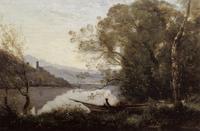
Souvenir of Italy (The Moored Boat)
Camille Corot
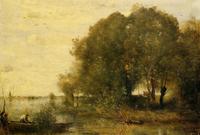
Wooded Peninsula
Camille Corot
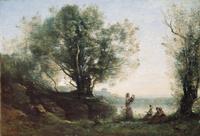
Orpheus Lamenting Eurydice
Camille Corot
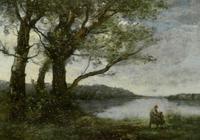
Three Trees with a View of the Lake
Camille Corot
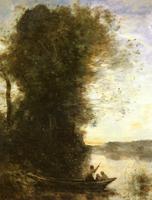
The Boatman Left the Bank with a Woman and a Child Sitting in his Boat, Sunset
Camille Corot
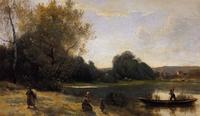
Ville d'Avray The Boat Leaving the Shore
Camille Corot
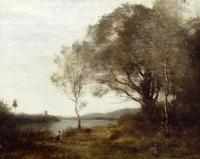
Strolling along the Banks of a Pond
Camille Corot
Landscape
Paul Trouillebert
The Bath of Diana
Camille Corot
A pond near Nangis
Paul Trouillebert
A quiet backwater
Paul Trouillebert
Recollections of Mortefontaine
Camille Corot
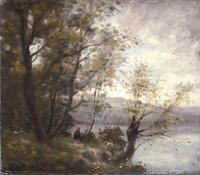
Landscape
Paul Trouillebert
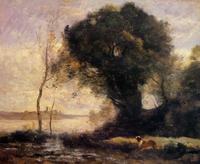
Pond with Dog
Camille Corot
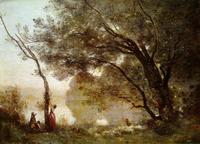
Souvenir of Mortefontaine
Camille Corot
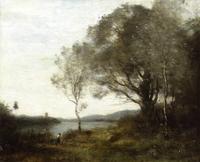
The Walk around the Pond
Camille Corot
Nemi, the Lake's Edge
Camille Corot
Large Sharecropping Farm
Camille Corot