Expert analysis of Camille Corot’s The Beach, Étretat
Style: Realism · Genre: landscape
Expert Art Historical Analysis: The Beach, Étretat by Camille Corot
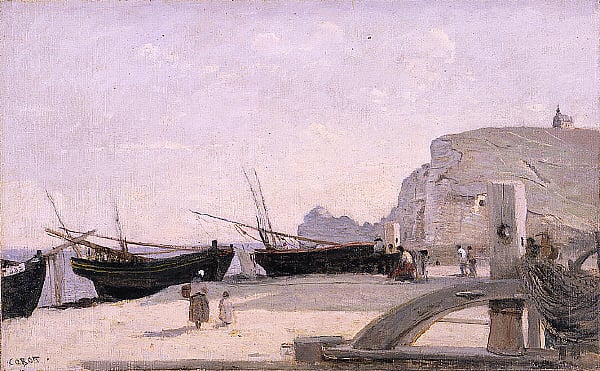
Camille Corot’s The Beach, Étretat stands as a pivotal example of Realist landscape painting, demonstrating the artist’s transition from idealized, Neoclassical compositions toward a more direct, observational approach to nature. Painted during the mid-19th century, the work captures the rugged Normandy coast with a restraint and tonal harmony that epitomize Corot’s unique blending of Realism with a poetic sensibility.
Significance within Realism:
- Fidelity to Place: Unlike earlier Romantic depictions of Étretat as a dramatic, sublime wilderness, Corot presents the beach as a quiet, everyday scene. The composition emphasizes natural, unembellished light and atmosphere, aligning with Realism’s core tenet—truth to observable reality.
- Plein Air Influence: Corot was a pioneer of working outdoors (en plein air), a practice later central to the Impressionists. Here, the soft, silvery tonality and subtle gradations of sky and water reflect his direct study of shifting coastal light, rather than studio contrivance.
- Structural Balance: While remaining faithful to the actual topography—the iconic cliffs and expansive shoreline—Corot imposes a calm, geometric order. The horizontal bands of sea, sand, and sky create a meditative stability, showing how Realism could elevate a simple beach scene to a timeless, harmonious vision.
Legacy and Influence:
Corot’s treatment of Étretat anticipates later works by Monet and Courbet, who also painted this coastline. However, Corot’s commitment to sincerity of vision—neither dramatizing nor sentimentalizing the landscape—makes The Beach, Étretat a touchstone for the Realist movement’s insistence on the beauty found in the ordinary. It demonstrates that Realism is not merely a documentary style but a deeply poetic engagement with the natural world, where light, atmosphere, and careful observation combine to reveal a profound and quiet truth.
Museum / Gallery
Visually similar
20 works with related composition and palette
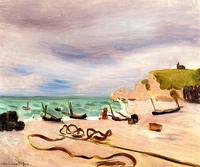
Ropes on the Beach at Etretat
Henri Matisse
Fishing Boats Aground and at Sea
Eugene Boudin
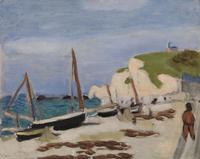
The Black Boat
Henri Matisse
Boats I
Joan Brull
Boats II
Joan Brull
The Beach, Berck
Eugene Boudin
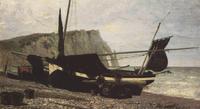
Fishing Boat. Etretat. Normandy.
Vasily Polenov
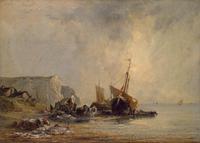
Boats by the Normandy Shore
Richard Parkes Bonington
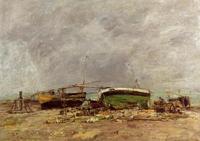
Etretat
Eugene Boudin
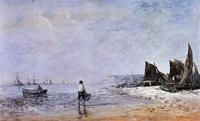
The Fisherman, Low Tide
Eugene Boudin
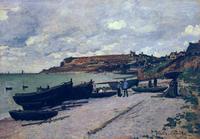
Sainte-Adresse, Fishing Boats on the Shore
Claude Monet
The Boat Yard
John Henry Twachtman
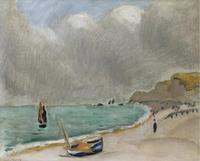
Le Rivage, Etretat
Henri Matisse
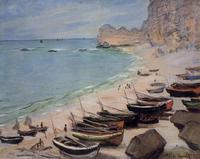
Boats on the Beach at Etretat
Claude Monet
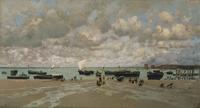
Mouth of the Bidasoa
Martín Rico y Ortega
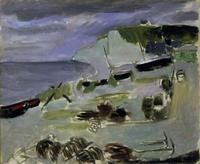
Boats on the Beach, Etrétat
Henri Matisse
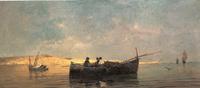
Fishing boat at dusk
Konstantinos Volanakis
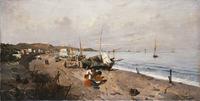
Boats and Children on the Beach
Konstantinos Volanakis
River Scene
James Webb
Skagen
Peder Severin Kroyer