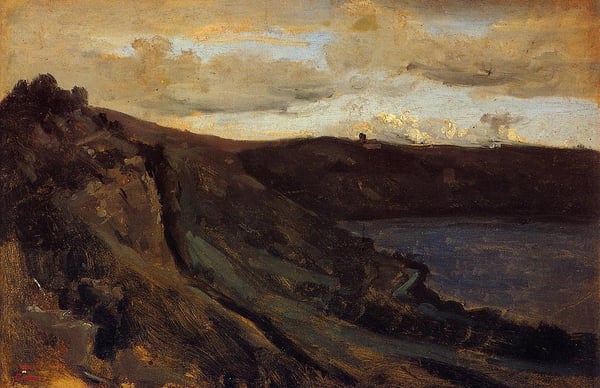
Analisi esperta di The Tibre River Hemmed in by the Collines di Camille Corot
Stile: Realism · Genere: landscape
Expert Analysis: "The Tibre River Hemmed in by the Collines" by Camille Corot
Background and Context
Camille Corot (1796–1875) is a pivotal figure in the evolution of landscape painting, bridging the Neoclassical tradition with the emerging Realist and later Impressionist movements. "The Tibre River Hemmed in by the Collines" (likely painted during Corot’s second Italian sojourn in the 1820s–30s) exemplifies his enduring fascination with the Roman countryside. The title itself—highlighting the river “hemmed in” by the hills (collines)—suggests a tension between natural enclosure and expansive sky, a theme Corot often explored.
Stylistic Significance within Realism
Corot’s work is celebrated for its quiet, lyrical naturalism. He rejected the idealized, mythologized landscapes of his academic predecessors, opting instead for direct observation of nature—a core tenet of Realism. Yet unlike some Realists who emphasized gritty social realities, Corot’s realism is one of atmospheric truth: the play of light, the subtle gradations of tone, and the unassuming grandeur of everyday terrain.
In this painting, the Tiber is not a grand allegorical river but a specific geographic feature, rendered with a soft, almost silvery palette. The “hemmed in” composition—with the river winding between softly modeled hills—creates a sense of intimacy and enclosure, directing the viewer’s eye toward the distant horizon. Corot’s brushwork is both delicate and assured: the foliage is suggested with loose dabs of green and gray, the water with gentle horizontal strokes, and the sky with a luminous, layered wash.
What Makes It Significant
-
A Mastery of Plein Air Observation: Corot was among the first to extensively paint outdoors (plein air), capturing the transient effects of light and weather. This painting demonstrates his ability to balance a classical sense of structure (the framing hills, the diagonal river) with a fresh, immediate response to nature. The result is a scene that feels both timeless and spontaneous.
-
Influence on Later Movements: Corot’s soft focus, tonal unity, and emphasis on atmosphere directly inspired the Barbizon School (Rousseau, Daubigny) and, crucially, the Impressionists. Monet and Renoir admired Corot’s ability to envelop a landscape in a cohesive mood—here, the diffuse light and muted earth tones anticipate the Impressionist preoccupation with the “envelope of air.”
-
The Realist Landscape as Sublime Stillness: Unlike the dramatic, sublime landscapes of Romanticism (e.g., Friedrich or Turner), Corot’s realism finds beauty in quiet, unremarkable moments. The Tiber is not a raging torrent but a placid waterway; the hills are not towering peaks but gentle slopes. This understated approach redefined landscape painting as a vehicle for meditative calm and perceptual truth.
Conclusion
"The Tibre River Hemmed in by the Collines" is a quintessential Corot: a Realist landscape that transcends mere documentation to become a study in harmony—between earth and sky, structure and fluidity, observation and poetry. Its significance lies not in dramatic narrative or political statement, but in its profound, refined sensitivity to the natural world. Corot’s influence echoes through generations of artists who sought to capture nature’s quiet soul.
Museum / Gallery
Visivamente simili
20 opere con composizione e palette affini
Valley Verde in Crepuscule
Henri Martin
Mountainous riverbank of Oyat
Vasily Polenov
Mount Soracte
Camille Corot
Sunset at Etretat
George Inness
Landscape of Xàtiva
Alejandro Cabeza
Mountainous Landscape
Camille Corot
View of mountains, Auvergne
Theodore Rousseau
Landscape
Paul Cezanne
Landscape near Villerville
Charles-Francois Daubigny
The vicinities of Saint Flour
Theodore Rousseau
Valley in the Auvergne
Theodore Rousseau
Sunset, Navarro Ridge, California Coast
Ralph Blakelock
La Mer En Corse, Le Scoud
Henri Matisse
Over the Dniester River
Margit Selska
Playing Pipes to the Setting Sun
Henri Martin
The Varangeville Church and the Cliffs
Pierre-Auguste Renoir
Bologne sur Mer, View from the High Cliffs
Camille Corot
Italienische Landschaft
Pierre-Henri de Valenciennes
Valley at Fontcouvert
Gustave Courbet
Coming of Spring
Frederick McCubbin