Analisi esperta di A Rising Path di Camille Corot
Stile: Realism · Genere: landscape
Expert Analysis of Camille Corot’s “A Rising Path”
Camille Corot’s “A Rising Path” stands as a quintessential example of the artist’s mature landscape style, which bridges the structured classicism of the 18th century and the emergent naturalism of 19th‑century Realism. Painted during a period when Corot was increasingly celebrated for his ability to capture the “truth of atmosphere,” this work demonstrates his profound influence on both the Barbizon school and the later Impressionists.
Significance within Realism and Landscape Tradition
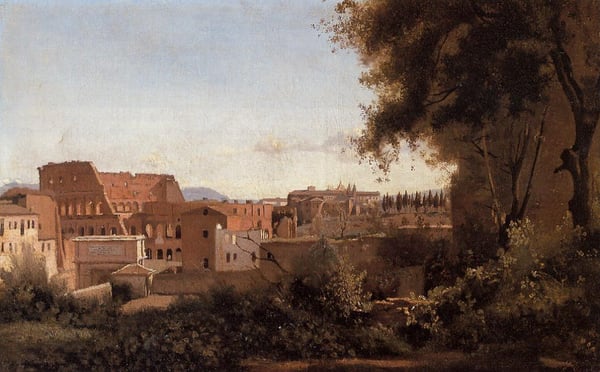
While Corot is often associated with the paysage historique (historical landscape) of the French Academy, “A Rising Path” belongs to his more intimate, plein‑air studies that align with the Realist ethos of depicting ordinary, unheroic nature. The painting rejects dramatic mountain vistas or mythological references in favor of a simple, meandering dirt path leading the eye upward through a wooded hillside. This humble subject matter—a path, a few trees, and a soft, overcast sky—exemplifies Realism’s commitment to everyday scenes rendered with fidelity to natural light and texture.
Technical and Compositional Mastery
Corot’s handling of light and atmosphere is the work’s central achievement. He employs a muted, silvery palette dominated by soft greens, warm ochres, and cool grays, unified by a thin, almost breathable application of paint. The path itself serves as a compositional device, guiding the viewer’s gaze diagonally from the lower foreground into the hazy middle distance—a classic Corot device that balances clarity with mystery. The trees are painted with delicate, feathery strokes of varying transparency, allowing patches of sky and distant hills to shimmer through. This technique, often called “Corot’s fog,” creates a sense of atmosphere that is at once palpable and poetic.
Historical and Stylistic Impact
“A Rising Path” is significant because it encapsulates Corot’s unique position as a transitional figure. Unlike his Realist contemporaries (Courbet, Millet) who often emphasized social or physical labor, Corot sought a quiet, lyrical truth in nature. His soft focus and luminous palette directly anticipated the Impressionist concern with fleeting light and optical sensation—artists like Pissarro and Monet studied his works intently. Yet Corot retains a structural weight absent in later Impressionism: the path’s gentle S‑curve provides a stabilizing geometry, while the subtle chiaroscuro anchors forms in space.
In essence, “A Rising Path” is remarkable not for a dramatic narrative but for its quiet mastery of mood and observation. It shows Corot refining Realism’s promise of truth into a personal, meditative vision that would echo through the rest of the 19th century.
Museum / Gallery
Visivamente simili
20 opere con composizione e palette affini
Forum Romanum with Colosseum
Johann Hermann Carmiencke
Roman Forum
D. Jeffrey Mims
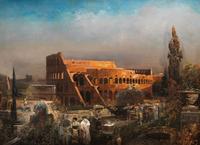
Colosseum in Rome (market people in front of the church of San Sebastiano al Palatino)
Robert Alott
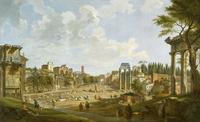
View of the Roman Forum
Giovanni Paolo Panini
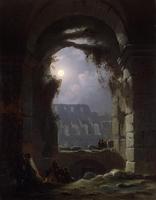
View of the Colosseum by Night
Franz Ludwig Catel
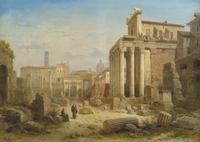
Forum Romanum
Albert Rieger
The Temple of Saturn
Frederick Lee Bridell
The Campo Vaccino, Rome
Claude Lorrain
Colosseum at Night
Carl Gustav Carus
VEDUTA DI CAMPOVACCINO
Antonio Joli
The Colosseum in the Moonlight
Frederick Lee Bridell
The Campo Vaccino, Rome
Claude Lorrain
A view of the Roman Forum with the Arch of Constantine, the Temple of Venus and the Meta Sudans at the centre
Ippolito Caffi
Untitled
Antonietta Raphael
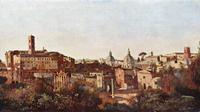
The Forum Seen from the Farnese Gardens
Camille Corot
View of the Campo Vacchino
Gaspar van Wittel
View of the Colosseum and the Arch of Constantine
Antonietta Brandeis
View of the Colosseum by Night
Franz Ludwig Catel
THE PROPERTY OF A GENTLEMAN
Paolo Anesi
In front of the Colosseum
Oswald Achenbach