Expertenanalyse zu Camille Corots Young Girl Learning to Write
Stil: Realism · Genre: genre painting
Expert Art Historical Analysis: "Young Girl Learning to Write" by Camille Corot
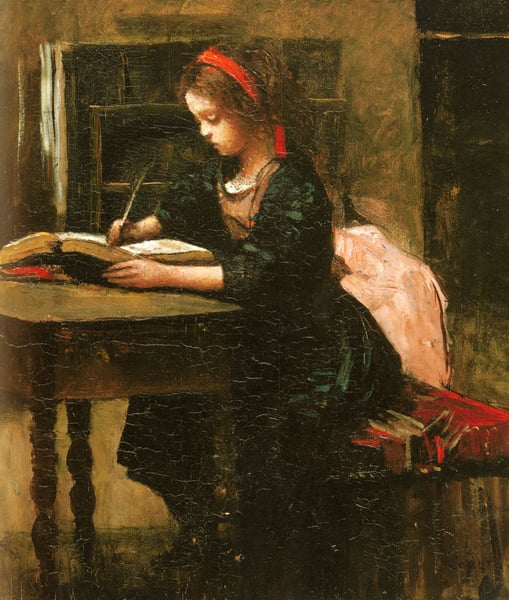
Camille Corot’s Young Girl Learning to Write stands as a compelling example of Realist genre painting, demonstrating the movement’s commitment to depicting the quiet dignity of everyday life. While Corot is best known for his poetic landscapes that bridge Neoclassicism and Impressionism, this intimate interior scene reveals his profound sensitivity to the human condition—a hallmark of Realism’s focus on unembellished, contemporary existence.
Significance within Realism and Genre Painting:
The painting’s significance lies in its subtle defiance of academic hierarchies. In mid-19th-century France, history painting and grand mythological subjects were considered the highest artistic pursuits. Corot instead turns his eye to a simple, unheroic moment: a young girl learning to write. This choice embodies the Realist credo—championed by artists like Courbet—that authentic art should arise from the observation of ordinary people and their daily activities.
Corot treats the subject with extraordinary tenderness and restraint. The girl’s concentrated posture and the quiet domestic setting evoke a sense of universal human experience—education, patience, and the transmission of knowledge. Unlike some Realist works that emphasize social critique or labor (such as Millet’s peasants), Corot focuses on a serene, private moment. The soft, diffused light and muted palette lend the scene a meditative quality, elevating the act of learning to a near-sacred ritual.
Artistic Technique and Style:
Although grounded in Realism, Corot’s handling of form and atmosphere presages later developments. The brushwork is gentle, avoiding harsh outlines, and the figures seem to emerge from a harmonious blend of shadow and light. This technique—sometimes called “Corot’s gray”—creates a poetic veil over the realism, suggesting an inner life beyond the literal scene. The girl’s downward gaze and the simple desk anchor the composition in observed reality, yet the blurred background and soft modeling hint at the introspective mood that would later inform Impressionist and Symbolist sensibilities.
Conclusion:
Young Girl Learning to Write is significant because it exemplifies how Realist genre painting could move beyond mere documentation to achieve a universal emotional resonance. Corot’s work here quietly insists that the most profound art can be found not in myth or history, but in a child’s first attempt to form letters—a humble, timeless act captured with remarkable sincerity and grace.
Museum / Gallery
Visuell ähnlich
20 Werke mit ähnlicher Komposition und Farbpalette
The successful letter
Adolf Eberle
Red jacket
Gerolamo Induno
Lesson on the Farm
Janos Tornyai
Girl Reading
Camille Corot
Girl Reading at the Window
Gwen John
Portrait of a Young Girl
Alexei Harlamoff
Girls
Alexei Harlamoff
The answer to the betrothed
Edward Portielje
The Convalescent
Helene Schjerfbeck
Leontine and Coco
Pierre-Auguste Renoir
Cards
Nikolaos Gyzis
Young Man Writing
Ernest Meissonier
Reading
Francesco Didioni
Young seamstress
Alexei Harlamoff
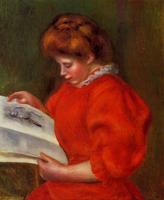
Young Woman Looking at a Print
Pierre-Auguste Renoir
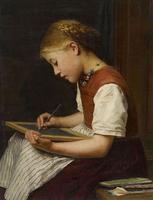
Schoolgirl doing homework
Albrecht Anker
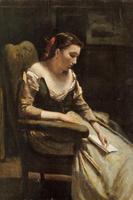
The Letter
Camille Corot
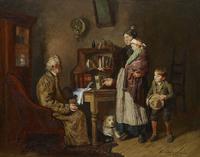
A concern
Felix Schlesinger
Reading by Candlelight
Petrus van Schendel
Painter kisses the model
Felix Schlesinger