Expertenanalyse zu Konstantin Korovins Murmansk coast (Pomor Crosses)
Stil: Art Nouveau (Modern) · Genre: landscape
Expert Analysis: "Murmansk Coast (Pomor Crosses)" by Konstantin Korovin
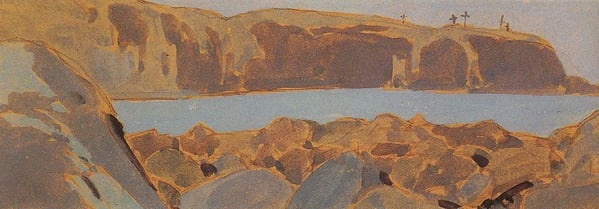
Konstantin Korovin’s "Murmansk Coast (Pomor Crosses)" is a striking example of how Art Nouveau (Modern) principles were applied to landscape painting at the turn of the 20th century. Although Korovin is often celebrated as a leading Russian Impressionist, this work—executed during his travels to the remote Russian North—reveals a deliberate shift toward the sinuous, decorative sensibility and heightened emotional atmosphere characteristic of the Art Nouveau aesthetic.
Significance within the Art Nouveau (Modern) Style:
- Synthesized Naturalism and Decorative Line: Rather than aiming for literal topographical accuracy, Korovin uses sweeping, organic contours—for instance, the rhythmic line of the shoreline and the silhouettes of the wooden Pomor crosses—to echo Art Nouveau’s hallmark “whiplash” curves. These crosses, stark against the sky, become almost abstract, ornamental motifs that anchor the composition.
- Atmospheric Color and Mood: The palette is restrained yet evocative: muted blues, grays, and earth tones, punctuated by the raw white of the crosses. This subdued color harmony aligns with Art Nouveau’s fascination with mood over mimetic replication, creating a sense of silent, northern spirituality.
- Integration of Cultural Symbolism: The Pomor crosses—traditional Russian Orthodox markers used by seafaring communities—are not mere documentary details. Korovin elevates them into expressive symbols of human presence within a vast, untamed nature, a common Art Nouveau preoccupation with the interplay of the spiritual and the natural.
Why This Landscape Matters:
In "Murmansk Coast", Korovin demonstrates that Art Nouveau landscape painting need not be confined to urban or floral decorative subjects. By applying the style’s fluidity and symbolic intensity to the austere, monumental landscape of the Russian Arctic, he expands the movement’s boundaries. The work bridges Russian national identity (the Pomor traditions) with a pan-European modernist language, marking a significant moment when regional specificity meets international avant-garde sensibility.
While the supplied facts restrict analysis to style and genre, the painting’s true significance lies in this fusion: a Modern landscape that transforms a remote coastal view into a resonant, almost hieratic composition—where every line and color serves an evocative, decorative purpose.
Visuell ähnlich
20 Werke mit ähnlicher Komposition und Farbpalette
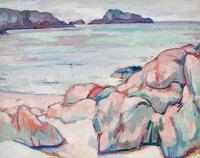
Iona
Samuel Peploe
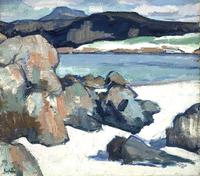
Iona Landscape. Rocks
Samuel Peploe
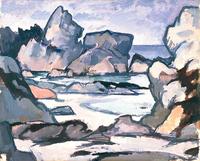
Rocks at Iona
Samuel Peploe
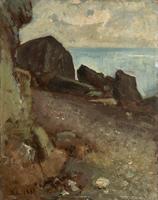
Rocks in Sestri Levante
Vincenzo Cabianca
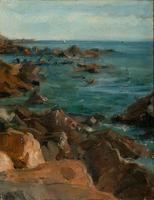
Rocky cliff in Sturla
Pellizza da Volpedo
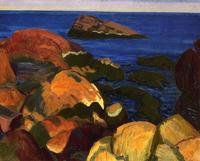
Rocks, Weeds and Sea
John French Sloan
Cliffs on the shore
Magnus Enckell
Krym - brzeg morza
Ferdynand Ruszczyc
A Rocky Shore, Iona
Samuel Peploe
Seashore
Paul Serusier
Cape Caliacra
Dumitru Ghiatza
Rocky Coast
Othon Friesz
Cliff
Vincenzo Cabianca
Bay of Monterey
Albert Bierstadt
Skala w morzu
Ferdynand Ruszczyc
Rocky seashore. Crimea
Arkhyp Kuindzhi
A Beach Scene
John Duncan
Rocks
Edward Hopper
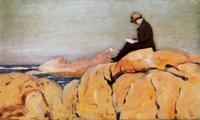
Cláudio nos Rochedos
Antonio Carneiro
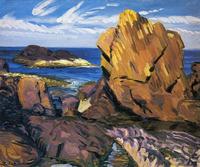
Yellow Rock, Gloucester
John French Sloan