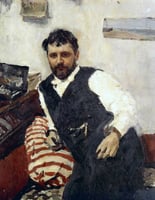
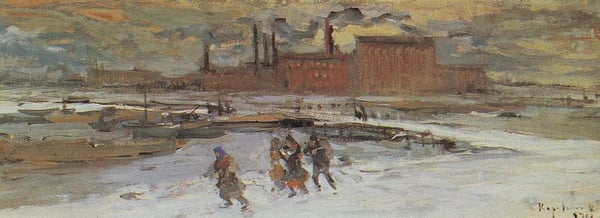
Expert analysis of Konstantin Korovin’s Landscape with Factory Buildings, Moscow
Style: Impressionism · Genre: cityscape
Expert Analysis of "Landscape with Factory Buildings, Moscow" by Konstantin Korovin
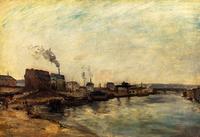
Konstantin Korovin’s Landscape with Factory Buildings, Moscow is a striking example of Russian Impressionism applied to an industrial cityscape, a subject rarely treated with such luminous modernity in late 19th‑century Russian art. The painting’s significance lies in how Korovin deploys the core tenets of Impressionism—rapid, broken brushwork; an emphasis on shifting light and atmosphere; and a vivid, often unblended palette—to transform the gritty reality of factory architecture into a scene of painterly vitality.
Unlike many Impressionists, who favored rural landscapes or urban leisure scenes (e.g., Parisian boulevards or gardens), Korovin turns his eye to Moscow’s industrial outskirts. The factory buildings are not depicted with documentary precision; instead, they are dissolved into patches of color and reflections, caught in a particular moment of daylight. This choice underscores the artist’s belief that even the most mundane, modern structures could be vehicles for capturing the fleeting effects of light—a central Impressionist ambition. By elevating an urban manufacturing site to the level of a lyrical landscape, Korovin asserts that beauty and visual truth can be found anywhere, including the burgeoning industrial world of Russia.
Within the context of his career and style, this work exemplifies Korovin’s role as a bridge between French Impressionism and a distinctly Russian sensibility. While he absorbed the techniques of Monet and Sisley during his travels in Europe, he consistently applied them to native subjects. Landscape with Factory Buildings, Moscow is therefore significant for its synthesis: it retains the spontaneity and optical brilliance of Impressionism while rooting the scene in the specific, modernizing environment of Moscow. The factory’s smokestacks and brick masses, rendered in soft, vibrating hues, become less a symbol of industrial pollution and more a demonstration of how the Impressionist eye can find harmony in the clash of nature and progress.
In summary, the work’s importance rests on its bold application of Impressionist technique to an industrial cityscape, its commitment to capturing transient light in an unlikely urban setting, and its role as a key document of Russian Impressionism’s adaptation of Western methods to local, modern reality.
Visually similar
20 works with related composition and palette
Port de Javel
Paul Gauguin
Amsterdam in the Snow
Claude Monet
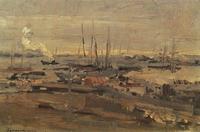
Arkhangelsk
Konstantin Korovin
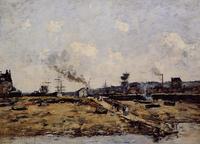
Trouville, the Ferry to Deauville
Eugene Boudin
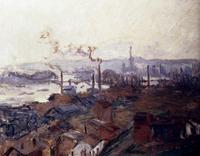
General View Of Rouen From St.Catherines Bank
Claude Monet
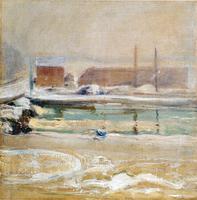
View from the Holley House, Winter
John Henry Twachtman
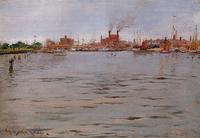
Harbor Scene, Brooklyn Docks
William Merritt Chase
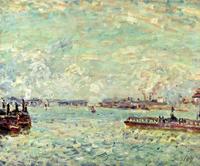
The Seine at Point du Jour
Alfred Sisley

Bridge in Winter
John Henry Twachtman
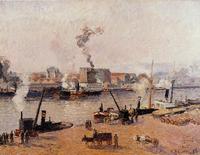
Foggy Morning, Rouen
Camille Pissarro
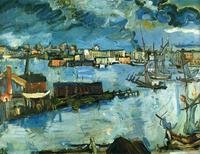
Stockholm Harbour
Oskar Kokoschka
The Seine, View from the Quay de Pont du Jour
Alfred Sisley
Fishermen on the Banks of the Oise
Camille Pissarro
Boats on the Thames, London
Claude Monet
The East River
William Merritt Chase
Drifting of ice
Aleksey Savrasov
Barja
Nikola Tanev
Winter Landscape
John Henry Twachtman
Sunset, The Port of Rouen (Steamboats)
Camille Pissarro
Port de Grenelle
Paul Gauguin