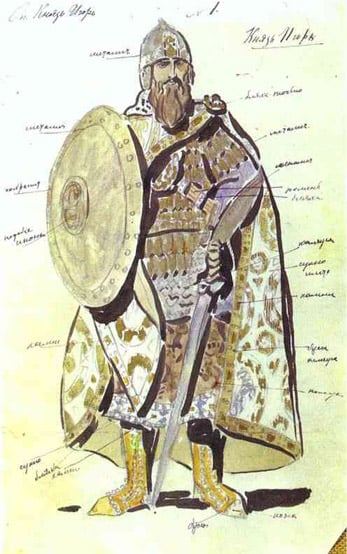
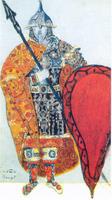
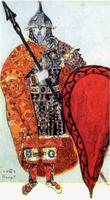
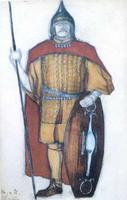
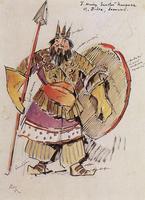
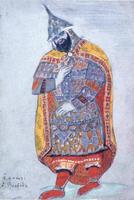
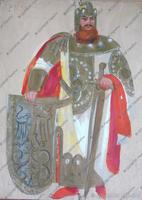
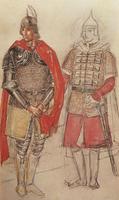
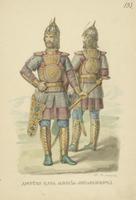
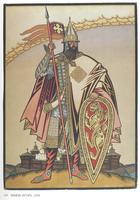
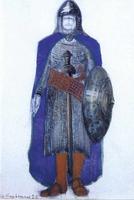
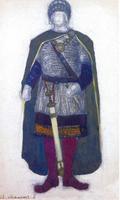
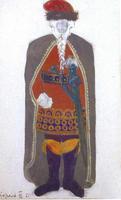
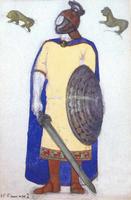
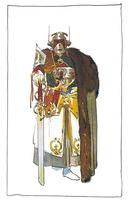
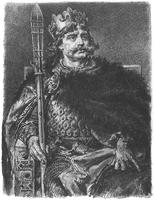
This costume design by Konstantin Korovin for the character Igor in the Mariinsky Theatre production of Prince Igor is a striking example of Art Nouveau applied to theatrical design. The significance lies in how Korovin synthesizes the movement’s defining principles—organic, flowing lines, rich ornamental detail, and a synthesis of the arts—with the historicist demands of a Russian epic opera.
As a design work within the Art Nouveau (Modern) style, the sketch does not merely document a garment; it becomes an autonomous decorative statement. Korovin likely employs sinuous, sweeping contours and a dynamic sense of movement in the drapery and armor, characteristic of Art Nouveau’s rejection of rigid academic forms. The interplay of bold, stylized patterns and jewel-toned color harmonies would have served both to evoke the medieval Kievan Rus' setting and to harmonize with the stage’s total visual environment—a core Art Nouveau ideal of Gesamtkunstwerk (total work of art).
Its significance is further amplified by its context: the Mariinsky Theatre was a premier institution, and Korovin was a leading Russian stage designer of the late 19th–early 20th centuries. This design likely contributed to the production’s immersive, symbolist-tinged aesthetic, breaking from naturalism to create a stylized, atmospheric world that complemented Borodin’s music. By translating the flat, decorative elegance of Art Nouveau into a wearable, three-dimensional form, Korovin’s work exemplifies how modern design principles modernized traditional opera, making the production both historically resonant and visually avant-garde.