Expert analysis of Konstantin Korovin’s In the ancient city
Style: Art Nouveau (Modern) · Genre: cityscape
Expert Analysis: "In the Ancient City" by Konstantin Korovin (Art Nouveau / Modern Cityscape)
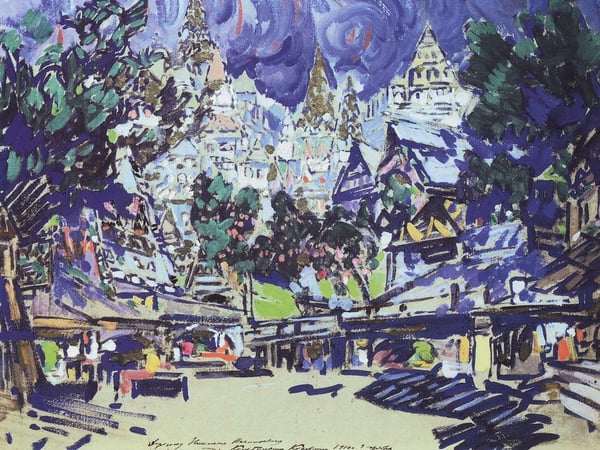
Konstantin Korovin’s In the Ancient City exemplifies a pivotal moment in the evolution of the modern cityscape, where Art Nouveau’s decorative ambitions meet the fleeting, atmospheric concerns of Impressionism. Although Korovin is often associated with Russian Impressionism, this work is significant for its Art Nouveau treatment of an urban subject—a rare synthesis that elevates the ordinary city into a shimmering, organic tapestry.
What makes this work significant within its style and period:
-
The Art Nouveau Cityscape as a Living Organism
Unlike earlier academic cityscapes that emphasized architectural precision or romantic ruins, Korovin applies Art Nouveau’s sinuous, rhythmic line to the ancient urban fabric. Walls, roofs, and canals seem to pulse with a natural, almost botanical vitality—the stone appears to grow, and light flows in curling, decorative patterns. This aligns with Art Nouveau’s core belief that modern art should infuse everyday life with beauty and movement, even in a historical setting. -
Mastery of Color and Atmosphere
Korovin’s palette—rich, jewel-like blues, ochres, and greens—recalls the stained-glass luminosity prized by Art Nouveau artists (e.g., Mucha, Tiffany). But here, the colors are not flat decorative fields; they are fragmented, vibrating strokes that capture the transient play of light on ancient surfaces. This fusion of decorative color harmony with impressionistic optical realism marks a modern departure from both strict Impressionism (too formless) and pure Art Nouveau (too planar). -
The “Modern” Gaze on the Past
The painting’s title, In the Ancient City, suggests a dialogue between old and new. Korovin does not treat the subject as a nostalgic relic; instead, he portrays it through a thoroughly contemporary lens—fast, expressive brushwork and compressed spatial depth. The ancient city feels alive, bustling with modern energy, yet its forms are softened into a dreamlike, decorative pattern. This reflects Art Nouveau’s fascination with transforming historical motifs into a modern visual language, a hallmark of the style’s most adventurous practitioners. -
Korovin’s Role as a Russian Modernist
While European Art Nouveau cityscapes (e.g., by Rysselberghe or Signac) often leaned toward pointillist precision, Korovin brings a distinctly Russian emotional and atmospheric intensity—a sense of light as a dramatic, almost theatrical force. This places In the Ancient City within the broader sphere of Mir iskusstva (World of Art), where artists like Korovin and Benois sought to harmonize Russian aesthetic traditions with Western modernism.
Conclusion:
In the Ancient City is significant for demonstrating that Art Nouveau was not confined to posters, jewelry, or furniture—it could animate the cityscape itself, transforming an ancient locale into a shimmering, modern vision. Korovin’s work stands as a bridge between the decorative idealism of Art Nouveau and the sensory immediacy of Impressionism, proving that the modern gaze could find its own radiant order in the weathered stones of history.
Visually similar
20 works with related composition and palette
Castle-Capital
Konstantin Korovin
Sketch for the opera, 'The Tale of Tsar Saltan', by Nikolai Rimsky Korsakov
Konstantin Korovin
Destruction of the Ghetto, Kyiv
Abraham Manievich
Czóbel Béla Hatvani Cigánysor
Bela Czobel
Margaret's Garden
Konstantin Korovin
Street in Soest
Christian Rohlfs
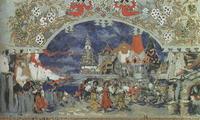
Trading Pier in the Capital City.Sketch of set for C. Pugni`s ballet
Konstantin Korovin
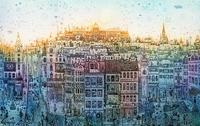
Gross Arnold , Kék Álmok Városa 1970
Gross Arnold
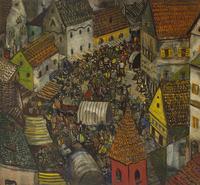
Shop Fair Old Torun
Petros Malayan
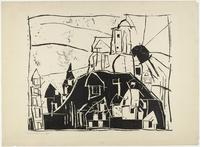
City on the Mountain (Stadt auf dem Berge)
Lyonel Feininger
The court of Prince Vladimir Galitsky (Study of scene design for "Prince Igor")
Nicholas Roerich
Study of decoration
Nicholas Roerich
Rostov Veliky. Kremlin.
Nicholas Roerich
View Of Heroldsberg
Albrecht Durer
Les Petit Maisons (drypoint)
Chaim Goldberg
View of Prague
Oskar Kokoschka
Tmutarakan
Nicholas Roerich
Czóbel Béla Hatvani Cigánysor
Bela Czobel
Methodist Chapel
Frances Hodgkins
Lauffenbourg
John Ruskin