Analisi esperta di Roses, fruit, wine di Konstantin Korovin
Stile: Impressionism · Genere: still life
Expert Analysis of "Roses, fruit, wine" by Konstantin Korovin
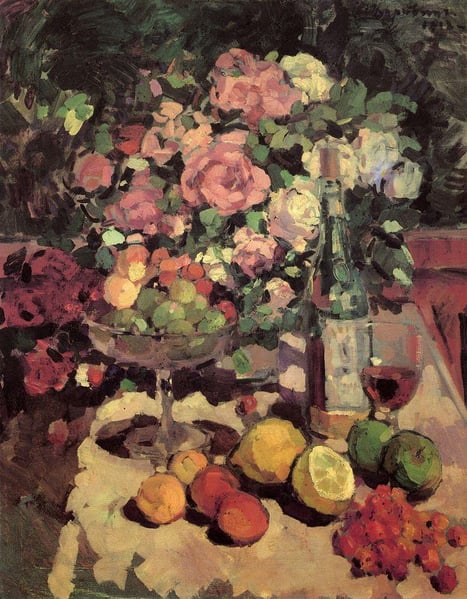
Konstantin Korovin’s "Roses, fruit, wine" stands as a luminous testament to Russian Impressionism—a style that Korovin helped define and elevate within the broader European movement. As a still life, the work transcends mere representation of objects; it becomes a study in atmosphere, fleeting sensation, and the interplay of light and color.
Significance within Impressionism and Korovin’s Oeuvre
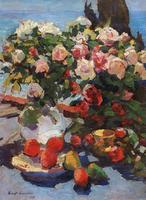
Korovin was among the first Russian artists to fully embrace Impressionist principles, rejecting the rigid academic conventions of his time. In this painting, the subject—roses, fruit, and wine—provides a perfect vehicle for his virtuosic handling of light and texture. The roses are not delineated with precise botanical detail but instead rendered as lush, vibrating dabs of pink, white, and deep red that capture the softness of petals and the warmth of sunlight. The fruit and wine gleam with reflected highlights, their surfaces broken into prismatic touches of color that suggest both form and the ephemeral quality of a moment.
The work’s significance lies in how Korovin treats the still life as an experience rather than an object study. The composition is casual, almost serendipitous—as if the viewer has just caught a glimpse of a table set for a leisurely meal. This informality is a hallmark of Impressionism, but Korovin infuses it with a distinctly Russian sensibility: a sense of intimate, lyrical pleasure that echoes the country’s own turn-of-the-century cultural flowering.
Furthermore, "Roses, fruit, wine" demonstrates Korovin’s mastery of color harmony. The bold reds of the roses and wine interplay with the cool greens of stems and leaves, while the pale, airy background allows these hues to sing. The brushwork—loose, energetic, and unapologetically visible—invites the viewer to appreciate the paint itself as a source of beauty, a radical idea that Korovin championed in Russia alongside his contemporaries.
Conclusion
In this still life, Korovin achieves what Impressionism sought: to capture a moment of pure sensory delight. The artwork is significant not only for its technical brilliance—the way light seems to breathe through the canvas—but also for its role in solidifying Impressionism as a vital force in Russian art. "Roses, fruit, wine" remains a vivid example of how Korovin transformed a simple domestic scene into a celebration of color, atmosphere, and the art of seeing.
Visivamente simili
20 opere con composizione e palette affini
Still Life with Blue Vase
Konstantin Korovin
Still Life
Konstantin Korovin
Roses in a Grey Jar
Samuel Peploe
Flowers and Fruit
Louis Valtat
Gursuf
Konstantin Korovin
Still Life with Fruit and Bottle
Konstantin Korovin
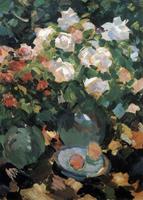
Roses in Blue Jugs
Konstantin Korovin
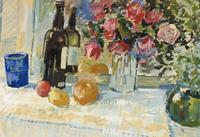
Still Life with a Bottle of Vine
Nikolay Bogdanov-Belsky
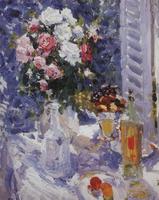
Flowers and Fruit
Konstantin Korovin
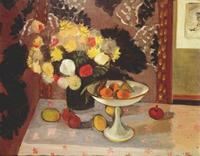
Still Life (Bouquet and Compotier)
Henri Matisse
Roses and Fruit
Konstantin Korovin
Roses
Konstantin Korovin
Still-life with Flowers and Fruits
Mihaly Munkacsy
Still Life with Fruit
Henri Matisse
Roses
Samuel Peploe
A bouquet of paper roses
Konstantin Korovin
Roses
Samuel Peploe
Modok Mária, Csendélet
Modok Mária
Still life with fruit
Mikhail Olennikov
Rose against the sea
Konstantin Korovin