Analisi esperta di In the boat di Konstantin Korovin
Stile: Impressionism · Genere: genre painting
Expert Analysis of "In the Boat" by Konstantin Korovin
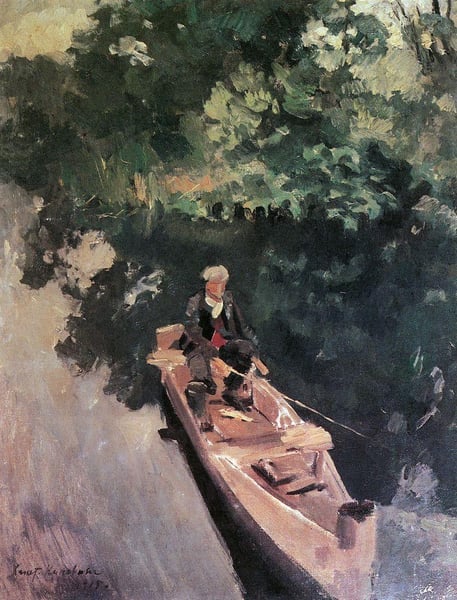
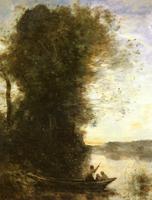
Konstantin Korovin’s “In the Boat” stands as a luminous exemplar of Russian Impressionism, demonstrating how the artist absorbed the core tenets of French Impressionism—dappled light, loose brushwork, and plein-air immediacy—while infusing them with a distinctively Russian sensibility. Painted in the genre of a tranquil leisure scene, the work captures a fleeting moment of intimacy and repose, focusing on figures adrift in a small vessel.
Significance within Impressionism & Russian Art
-
Mastery of Light and Atmosphere:
Korovin, like his French contemporaries, prioritizes the optical effects of natural light over narrative detail. In “In the Boat,” the shimmering reflections on the water, the interplay of sunlight filtering through foliage, and the soft, broken color patches (especially in the water and sky) all attest to his obsession with capturing the impression of a moment. The boat’s occupants are rendered not as distinct individuals but as part of a unified, vibrant tableau—a hallmark of Impressionist fleetingness. -
Russian Adaptation of the Style:
While the French Impressionists often depicted Parisian boulevards or suburban leisure, Korovin chooses a deeply Russian setting: a quiet, possibly northern river scene, with muted yet warm greens and blues. This work is significant for showing that Impressionism could thrive outside France—Korovin adapts the palette to the softer, more humid light of central Russia, avoiding the high-key brilliance of Monet in favor of a more lyrical, melancholic atmosphere. -
Genre Painting Elevated to Poetic Observation:
The genre is everyday life—a simple boat outing—but Korovin transforms it into a study of human stillness and nature’s flux. The painting’s significance lies in its lack of overt narrative; instead, meaning arises from the delicate balance of color harmonies (sky blues, water reflections, clothing accents) and the rhythmic placement of figures and oars. This focus on pure visual sensation was progressive for Russian art of the time, moving away from the narrative-heavy works of the Peredvizhniki. -
Brushwork and Texture:
The loose, almost sketchy application of paint—visible dabs and strokes that coalesce only at a distance—underscores Korovin’s commitment to the Impressionist principle of capturing spontaneity. This technique gives the water a shimmering, kinetic quality, while the figures remain slightly soft-focus, as if seen through the haze of summer warmth.
Conclusion:
“In the Boat” is significant as a meeting point between French Impressionist innovation and Russian pictorial tradition. Korovin proves that the style’s core concerns—light, color, atmosphere—are universally translatable, producing a work that feels both intimate and timeless. It exemplifies his role as a pioneer of Russian Impressionism, valuing sensory experience over anecdote and paving the way for later modernists in his country.
Visivamente simili
20 opere con composizione e palette affini
Landscape
Konstantin Korovin
Mrs. Chase in Prospect Park
William Merritt Chase
Banks of the Yerres
Gustave Caillebotte
Fisherman on a poldercanal
Cornelis Vreedenburgh
Clearing After Rain, Maganatawan River, Ontario
J. E. H. MacDonald
The skiff
Pierre-Auguste Renoir
Banks of the Canal
Henri Matisse
Near the Ferry
Sergiy Grigoriev
Boy in a Boat Fishing
Theodore Robinson
By the Riverside.
Isaac Levitan
November
Guy Rose
Grey Day on the River (also Known as Two Ladies in a Boat)
Frederick Carl Frieseke
The Thames at Benson, Oxfordshire
Albert Chevallier Tayler
In a Boat
Victor Borisov-Musatov
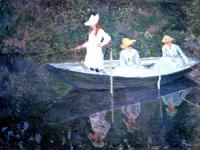
In the Norvegienne Boat at Giverny
Claude Monet
Boat on a Pond
Charles-Francois Daubigny
Sutton Courtenay, (Summer on the River or The Wharf)
John Lavery

Woman in a Boat
Pierre-Auguste Renoir
On boat (Study to "The Conquest of Siberia by Yermak")
Vasily Surikov
The Boatman Left the Bank with a Woman and a Child Sitting in his Boat, Sunset
Camille Corot