Konstantin Korovin sanatçısının Portrait of a Woman eseri hakkında uzman analizi
Tarz: Impressionism · Tür: portrait
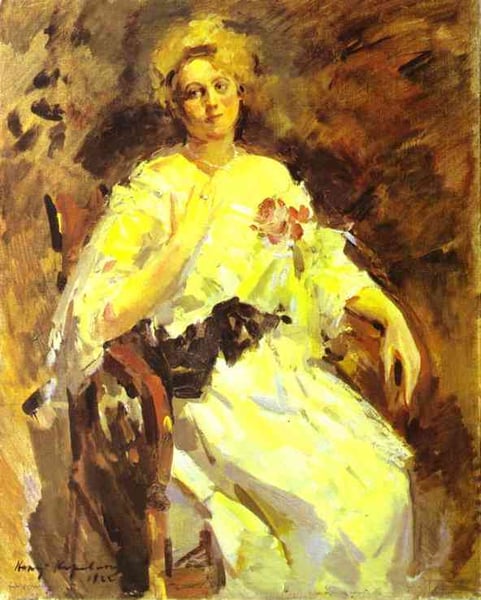
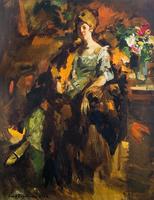
This analysis focuses on the significance of "Portrait of a Woman" by Konstantin Korovin within the context of Impressionism and the portrait genre.
Konstantin Korovin is a pivotal figure in Russian Impressionism, a movement that adapted the French Impressionist emphasis on light, color, and spontaneity while infusing it with a distinctly Russian sensitivity. What makes this portrait significant is how Korovin applies Impressionist principles—typically associated with landscapes and scenes of modern life—to the intimate, traditionally structured genre of portraiture.
Significance through Technique and Mood: In this work, Korovin prioritizes atmosphere over precise likeness. Rather than building the sitter’s face through meticulous line and shadow, he uses rapid, visible brushstrokes—a hallmark of Impressionism—to capture the fleeting effect of light on skin and fabric. The colors are likely vibrant and unblended, with contrasts between warm and cool tones defining form rather than contour. This loose, painterly approach suggests the woman is caught in a moment of quiet, absorbed presence, which aligns with the Impressionist goal of painting en plein air or capturing a “snapshot” of life.
Significance within Russian Impressionism: Korovin helped lead the shift from the narrative, moralizing art of the Russian Realists (like the Peredvizhniki) toward a more decorative, sensory experience. “Portrait of a Woman” represents this transition: the sitter is not a hero or a symbol but simply a subject of light and mood. The background likely dissolves into patches of color, focusing attention on the interplay of reflection and shadow across the face and costume. This technique elevates the ordinary into the lyrical, demonstrating Korovin’s belief that “art is not a document but a poem.”
Significance in Genre: Within the portrait genre, Korovin’s work is significant because it rejects the stiff, formal conventions of academic portraiture. Instead, he treats the human face and figure as yet another surface on which to observe the mutability of light and color. The woman’s individual psychology is suggested not through detailed features but through the overall harmony of her pose and the emotional temperature of the palette—often warm, golden tones in Korovin’s work that evoke a sense of intimacy and nostalgia.
In summary, “Portrait of a Woman” is significant because it exemplifies how Russian Impressionism merged French techniques with local sensibilities, and how Korovin used the portrait format to pursue pure visual poetry over narrative or exact reproduction. It stands as a testament to the artist’s role in modernizing Russian art, making the transient beauty of light itself the true subject of the work.
Museum / Gallery
Görsel olarak benzer
İlişkili kompozisyon ve renk paletine sahip 20 eser
Ritratto di signora con fiori
Giovanni Boldini
Dame in avondtoilet
Isaac Israels
Woman portrait
Konstantin Korovin
Dreamy
Gustavo Simoni
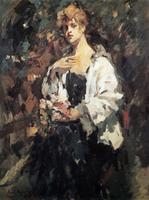
Portrait of Z. Pertseva
Konstantin Korovin
Portrait of Jane Bury, seated half-length, in a blue dress, holding a book
Edward Arthur Walton
Woman
Stefan Luchian
Portrait of Mrs. Zofia Brzeska
Teodor Axentowicz
Portrait of Miss Scobell in a Bathchair (The Convalescent)
Philip Wilson Steer
Princess Aristizza Ghyka
George Demetrescu Mirea
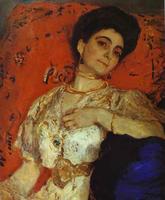
Portrait of Maria Akimova
Valentin Serov
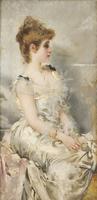
Portrait of a young woman
Vittorio Corcos
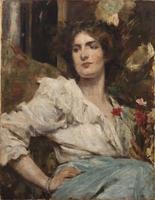
Female portrait
Alessandro Zezzos
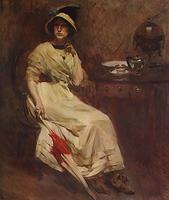
Retrato de Mª Cristina Bordalo Pinheiro
Columbano Bordalo Pinheiro
Mrs. Edmond Kelly
John Singer Sargent
Lonovics Kornélia Kisasszony Képmása
Károly Lotz
Misia with a Pink Corsage
Pierre Bonnard
Ferenczy Károly, Dr Weiner Adolfné Képmása 1907
Karoly Ferenczy

Mrs. Leeds, the later Princess Anastasia of Greece (and Denmark)
Giovanni Boldini
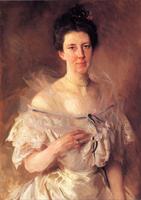
Mrs. Gardiner Greene Hammond (Esther Fiske Hammond)
John Singer Sargent