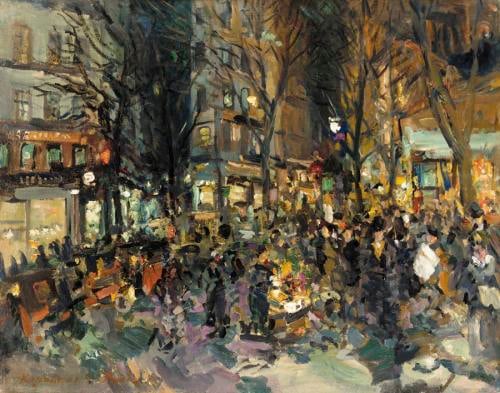
Parisian Street
Analisi esperta di Parisian Street di Konstantin Korovin
Stile: Impressionism · Genere: cityscape
Expert Analysis: "Parisian Street" by Konstantin Korovin
Konstantin Korovin’s Parisian Street exemplifies the artist’s distinctive fusion of Russian Impressionism with the urban vibrancy of fin-de-siècle Paris. Painted during his extended stays in France (often between 1890 and 1910), the work captures the fleeting energy of a city transformed by modernity—a core concern of Impressionism itself.
Stylistic and Period Significance
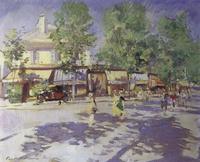
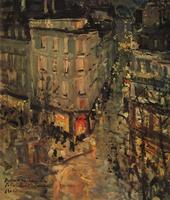
As a cityscape in the Impressionist mode, Parisian Street prioritizes atmospheric effects over topographical accuracy. Korovin employs a rapid, broken brushwork and a high-keyed palette—favoring luminous blues, pearly grays, and subtle golds—to render the play of light on wet pavements, passing carriages, and the hazy silhouettes of Haussmannian buildings. This technique aligns with the Impressionist goal of capturing a transient moment, but Korovin infuses it with a distinctly Russian sensibility: a warmth of tone and a looser, more emotional handling of paint that recalls the lyrical quality of his earlier work in the Russian North.
What Makes It Significant Within Its Style/Period
-
Cultural Bridge: Korovin was a leading figure in Russian Impressionism, a movement that adapted French techniques to Russian subjects. Parisian Street is significant because it demonstrates how Russian artists not only absorbed but also transformed the International Impressionist style to suit a foreign urban environment. The street is not merely a Parisian cliché; it pulses with a subtle, almost melancholic energy that distinguishes it from the sunnier, more casual views of the city by French contemporaries like Renoir or Monet.
-
Speed and Spontaneity: This work epitomizes the Impressionist obsession with plein air immediacy. Korovin often painted on site, and the sketch-like quality of Parisian Street suggests he worked quickly to seize the shifting light and the bustle of pedestrians and horse-drawn omnibuses. The lack of tight linear detail forces the viewer’s eye to blend the dabs of color from a distance, recreating the optical experience of a fleeting glance.
-
Russian Reception of Modernity: For early 20th-century Russian audiences, Parisian Street presented a vision of modern European life that was both alluring and foreign. Korovin’s decision to focus on the street rather than iconic monuments reflects a core Impressionist interest in the everyday, fleeting rituals of city life—a subject that was still novel in Russian painting, which tended toward narrative or landscape subjects.
In sum, Parisian Street is significant not just as a competent Impressionist cityscape, but as a testament to the international reach of Impressionism and the unique cultural lens through which Korovin translated Paris into paint. It stands as a key work in the dialogue between Russian art and Western European modernism.
Visivamente simili
20 opere con composizione e palette affini
Paris.Cafe de la Paix
Konstantin Korovin
Paris boulevard
Konstantin Korovin
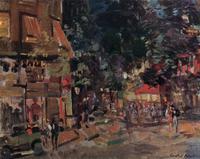
Montmartre in the evening
Konstantin Korovin
After the rain. Paris
Konstantin Korovin
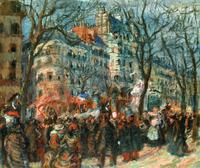
Carnival on the Grands Boulevards
Raoul Dufy
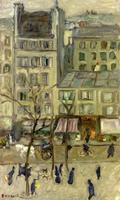
Boulevard des Batignolles
Pierre Bonnard
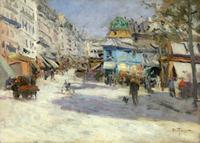
Rue Lepic, the corner of Rue Puget and Place Blanche
Louis Abel-Truchet
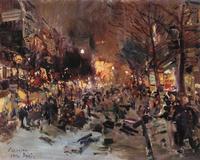
Boulevard in Paris
Konstantin Korovin
Montparnasse (Paris)
Bela Czobel
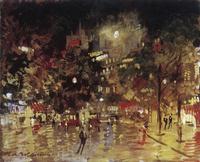
Paris by Night
Konstantin Korovin
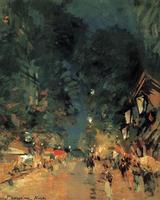
Nice.Street at night
Konstantin Korovin
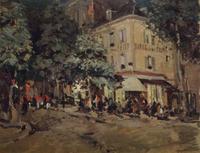
A Street in Vichy
Konstantin Korovin
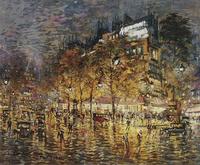
Paris
Konstantin Korovin
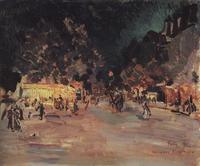
Paris at Night
Konstantin Korovin
Vichy
Konstantin Korovin
Greenish Bus in Street of Paris
Grant Wood
The Fourteenth of July Celebration in Paris
Vincent van Gogh
Paris after Rain
Konstantin Korovin
Paris in the morning
Konstantin Korovin
Paris. Boulevard des Capucines
Konstantin Korovin