Expert analysis of Konstantin Korovin’s At the Open Window
Style: Impressionism · Genre: genre painting
Expert Analysis: At the Open Window by Konstantin Korovin
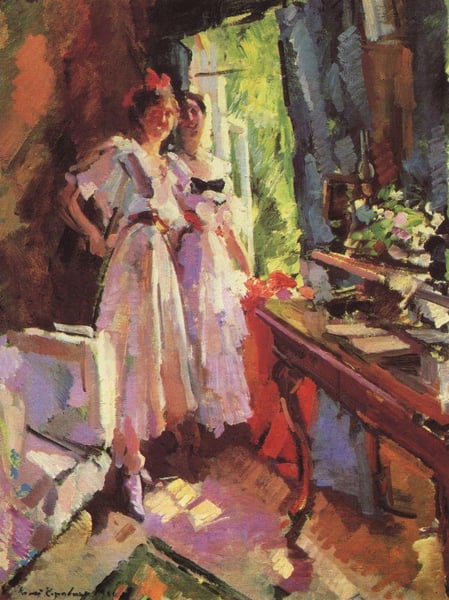
Konstantin Korovin’s At the Open Window stands as a quintessential example of Russian Impressionism, a movement that adapted French Impressionist techniques to distinctly Russian subjects and sensibilities. Painted at the turn of the 20th century, this genre scene captures a moment of intimate, everyday life, yet transforms it through a masterful handling of light and color that elevates the ordinary into the lyrical.
Significance within Impressionism and Russian Art
Korovin was a leading figure in Russian Impressionism, and this work exemplifies his break from the somber realism of the earlier Peredvizhniki (The Wanderers) movement. In At the Open Window, he abandons narrative storytelling in favor of pure visual sensation. The open window serves as both a compositional device and a metaphor for a new artistic freedom—the threshold between interior and exterior, domesticity and nature, tradition and modernity.
Light, Color, and Atmosphere
The painting’s significance lies in Korovin’s treatment of light as the true subject. Sunlight floods through the window, casting dappled patterns across the interior. Korovin uses a bright, high-key palette with rapid, visible brushstrokes to capture the transient effects of natural light—a hallmark of Impressionism. The contrast between the cool shadows of the room and the warm, luminous exterior creates a vibrant optical harmony. The figure (likely a friend or model) is not the focal point so much as a part of this ambient environment; her pensive pose integrates into the play of light and shadow, emphasizing mood over action.
Genre Painting as a Vehicle for Modernity
As a genre painting, At the Open Window is significant for redefining the genre itself. Rather than depicting peasant life or moralizing scenes (common in earlier Russian genre works), Korovin focuses on a quiet, private moment of contemporary urban or dacha life. This shift reflects a broader cultural move toward subjectivity and personal introspection in late 19th-century Russian art. The open window motif—frequent in Korovin’s œuvre—also connects Russian Impressionism to European trends, particularly the works of artists like Berthe Morisot and Pierre-Auguste Renoir, who similarly explored the interplay of interior space with the outside world.
Legacy
At the Open Window is celebrated for its spontaneity and freshness, qualities that Korovin championed over academic finish. It demonstrates how Russian artists embraced Impressionism not as a mere imitation of French models but as a means to express a uniquely Russian sensibility—a love of fleeting beauty, emotional subtlety, and the poetry of everyday life. This painting remains a key work in understanding the transition from 19th-century realism to the more expressive, color-driven art of the Russian avant-garde.
Museum / Gallery
Visually similar
20 works with related composition and palette
Young Woman in front of a Mirror
Anna Ancher
Winter twilight
Konstantin Korovin
La Toilette
Henri Gervex
The lady on the chair
Konstantin Korovin
The Cheval Glass
Berthe Morisot
Winter sun
Konstantin Korovin
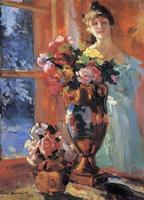
Still life with portrait of Pertseva
Konstantin Korovin
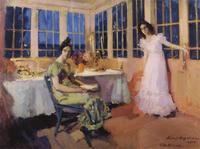
Terrace
Konstantin Korovin
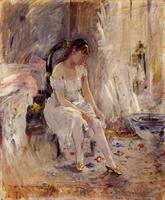
Young Girl Putting on Her Stockings
Berthe Morisot
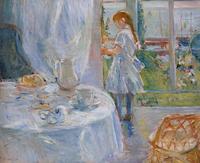
Cottage Interior (also known as Interior at Jersey)
Berthe Morisot
On terrace
Konstantin Korovin
Woman Sewing
Philip Wilson Steer
A Woman at a Sunny Window
Carl Holsøe
Dress Show at Hirsch
Isaac Israels
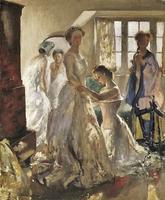
Matinee Rehearsal
Henry Tonks
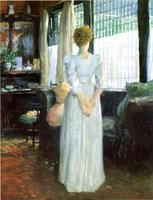
In the Living Room
Julian Alden Weir
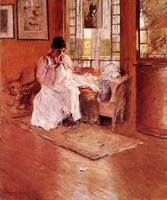
For the Little One, aka Hall at Shinnecock
William Merritt Chase
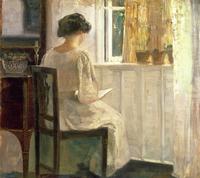
Girl Reading in a Sunlit Room
Carl Holsøe
Night
Konstantin Korovin
At the Window
Konstantin Korovin