
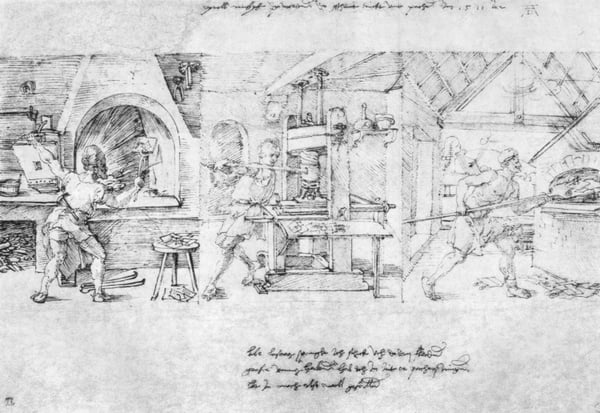
Caricature of Lazarus Spengler
Albrecht Durer sanatçısının Caricature of Lazarus Spengler eseri hakkında uzman analizi
Tarz: Northern Renaissance · Tür: caricature
Expert Analysis: "Caricature of Lazarus Spengler" by Albrecht Dürer
Albrecht Dürer, the towering figure of the Northern Renaissance, is celebrated for his meticulous engravings, self-portraits, and religious works that fuse German Gothic precision with Italian Renaissance humanism. Yet this lesser-known piece, a caricature of the Nuremberg city scribe and reformer Lazarus Spengler, reveals a playful, satirical side of the master—one that underscores the era’s shifting attitudes toward individuality and social critique.
Significance within the Northern Renaissance and Dürer’s Oeuvre
-
A Rare Example of Renaissance Caricature
While the genre of caricature—deliberate distortion for comic or critical effect—would not be formally codified until the 17th century (notably by the Carracci), Dürer’s drawing anticipates it. In the Northern Renaissance, portraiture was typically solemn, intended to convey status or piety. By exaggerating Spengler’s features—likely a prominent nose, heavy brows, or a sardonic expression—Dürer deviates from idealized representation to capture personality with humor. This personalizes the humanist circle of Nuremberg, where Spengler was a key ally of Martin Luther; the caricature may even signal Dürer’s wry commentary on the reformer’s earnest intensity. -
Mastery of Line and Expression
Even in a seemingly casual sketch, Dürer’s draftsmanship shines. The swift, confident strokes—perhaps in pen and ink—reveal his deep understanding of facial anatomy and proportion, which he deliberately twists. The caricature is not crude mockery but an intelligent distortion: the enlarged features remain recognizable, demonstrating Dürer’s ability to manipulate realism while retaining likeness. This technical feat anticipates later caricaturists like Leonardo da Vinci, who also studied “grotesque” heads. -
Historical and Intellectual Context
Lazarus Spengler (1479–1534) was a prominent lay theologian and city official who championed Lutheran reforms. Dürer’s choice to caricature a friend and intellectual peer suggests a culture of intimate, witty exchange among Nuremberg’s elite. Unlike the formal portraits Dürer produced for patrons, this work was likely private—a visual joke shared within a humanist circle. It humanizes Dürer, showing him as both a keen observer of personality and a participant in the Northern Renaissance’s emerging self-awareness and irony. -
A Precursor to Modern Satire
In an age when art was largely ceremonial or devotional, this caricature stands out as an early example of art used for social commentary. It blurs the line between portraiture and satire, offering a mischievous glimpse behind the public facade of Reformation politics. For historians, it provides rare evidence that Renaissance artists used humor to navigate the tensions of their time—between tradition and reform, piety and humanism.
Conclusion
Though small in scale, Dürer’s Caricature of Lazarus Spengler is a significant outlier in his body of work and Northern Renaissance art. It demonstrates that the era’s drive for naturalism could also embrace playful distortion, and that the humanist fascination with the individual extended to the comical. This drawing is a testament to Dürer’s versatility and his role as a forerunner of modern artistic satire—proving that even the most serious of Renaissance masters knew how to laugh.
Görsel olarak benzer
İlişkili kompozisyon ve renk paletine sahip 20 eser
The Peasant Settling His Debt
Adriaen van Ostade
Journey to the Center of the Earth
Edouard Riou
The Etcher
George Elbert Burr
Salt Petre
Paul Revere
Mangle with Two Women and a Man
Vincent van Gogh
The Family
Adriaen van Ostade
Woman baking bread
Jean-Francois Millet
Man drawing a Lute
Albrecht Durer
Illustrations for Mikhail Stelmakh's book "In the Hedgehog's Windmill"
Hryhorii Havrylenko
La Chanson Des Marechaux
Theophile Steinlen
Weaver, with a Baby in a Highchair
Vincent van Gogh
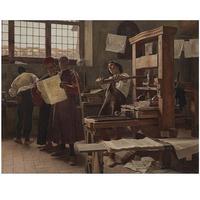
Bernardo Cennini stampatore nella sua bottega
Tito Lessi
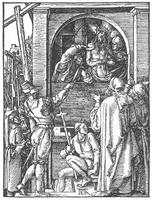
Christ Shown to the People
Albrecht Durer
Male wood cutter and female wood cutter (or Wood splitter), after a drawing by Johann Josef Schindler
Johann Nepomuk Passini
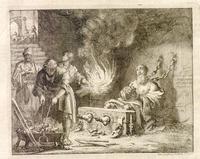
Torture of Origen, Alexandria, AD 234
Jan Luyken
The Fat Kitchen
Pieter Bruegel the Elder
The Iron Forge
Joseph Wright
The Thin Kitchen
Pieter Bruegel the Elder
St. Jerome In His Study (Without Cardinal`s Robes)
Albrecht Durer
The dance of death: the child
Hans Holbein the Younger