
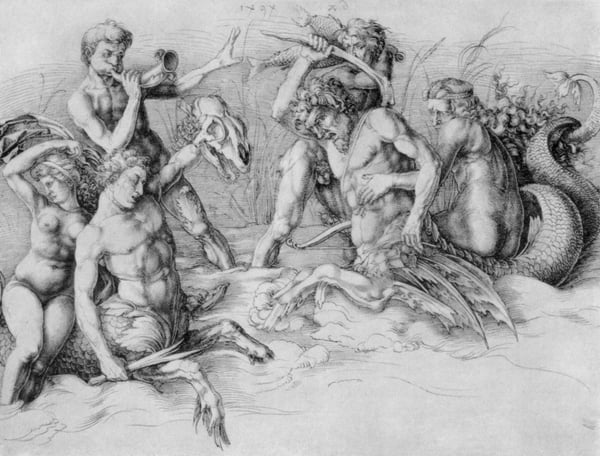
Expert analysis of Albrecht Durer’s Fighting Seekentauren
Style: Northern Renaissance · Genre: mythological painting
Expert Analysis: "Fighting Seekentauren" by Albrecht Dürer
As a Northern Renaissance mythological painting, Albrecht Dürer’s Fighting Seekentauren stands as a pivotal fusion of classical narrative and Northern European naturalism. The work exemplifies how artists of this period reinterpreted ancient myths through an intensely observed, detailed lens distinct from their Italian contemporaries.
Significance within the Northern Renaissance
Dürer’s treatment of a mythological subject—here a battle among sea centaurs—demonstrates the Northern Renaissance’s embrace of humanist themes while retaining a characteristically Germanic devotion to meticulous surface description. Unlike the idealized, harmonious forms of Italian art, Dürer imbues the scene with a raw, almost grotesque physicality. The combatants are rendered with precise anatomical realism, yet their hybrid bodies (man and horse, merged with aquatic elements) explore the era’s fascination with the monstrous and the symbolic.
Key aspects of its importance
- Syncretism of Northern and Italian influences: While the theme derives from classical mythology (popularized in Italy), Dürer applies the Northern tradition of engraving and detailed linework. The result is a dynamic composition that balances violent action with ornamental intricacy—a hallmark of Dürer’s graphic mastery.
- Allegorical undercurrent: The fighting centaurs likely represent primal forces or inner human conflict, a common Northern Renaissance use of myth to convey moral or philosophical messages. The chaotic struggle mirrors the period’s anxieties about order and nature.
- Technical virtuosity: As an engraving, the work showcases Dürer’s unparalleled skill in rendering texture, emotion, and movement through cross-hatching and tonal variation. This technical sophistication elevated the print medium, making mythological scenes accessible beyond aristocratic patrons.
In summary, Fighting Seekentauren is significant because it encapsulates the Northern Renaissance’s unique synthesis of classical learning with empirical observation, while also marking Dürer’s contribution to the diffusion of mythological imagery across Europe. It is a vital example of how Northern artists claimed ownership of ancient stories, grounding them in a tangible, often unsettling reality.
Museum / Gallery
Visually similar
20 works with related composition and palette
The Battle of Sea Gods
Andrea Mantegna
Bacchanal with Silenus
Albrecht Durer
Bacchanal in Silene
Andrea Mantegna
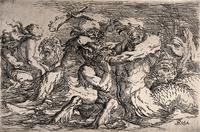
Sea Monsters Fighting
Salvator Rosa
Molorchos making a sacrifice to Hercules
Andrea Mantegna
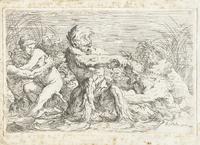
Tritons Fighting Over A Nereid
Salvator Rosa
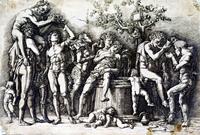
Bacchanalia with a Wine
Andrea Mantegna
The Inferno, Canto 18
Gustave Dore
Silenus (or Bacchus) and Satyrs
Peter Paul Rubens
Five Male Nudes
Albrecht Durer
Silen, Satyr and Bacchanals
Karl Bryullov
Devils and Seducers
Gustave Dore
Removal Dejanira
Gustave Moreau
The Dead Christ
Hans Baldung
Cult of Bacchus
Jan Saenredam
The Inferno, Canto 21
Gustave Dore
The Dragon Devouring the Companions of Cadmus
Hendrick Goltzius
Galatea on a sea monster
Giovanni Battista Piranesi
Study of Nudes
Luca Signorelli
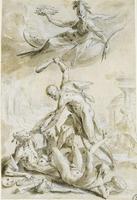
Hercules defeating the vices
Hans von Aachen