Expertenanalyse zu Albrecht Durers Head of a Stag
Stil: Northern Renaissance · Genre: animal painting
Expert Analysis: "Head of a Stag" by Albrecht Dürer
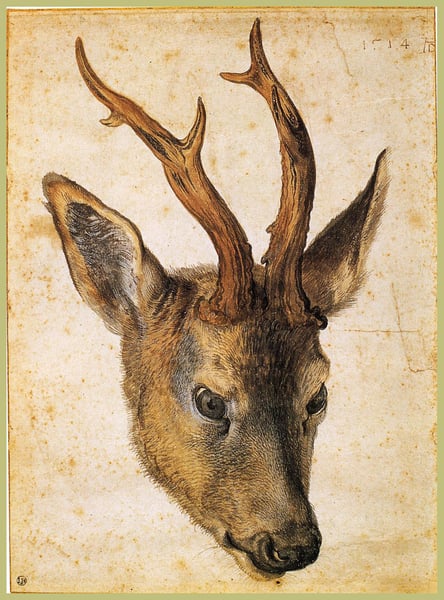
As a masterwork of the Northern Renaissance, Albrecht Dürer’s Head of a Stag exemplifies the period’s revolutionary shift toward empirical observation and naturalistic detail. While Dürer is celebrated for his engravings and altarpieces, his animal studies—including this piece—are groundbreaking in their fusion of scientific precision and symbolic depth.
Significance within the Northern Renaissance:
The Northern Renaissance placed a premium on meticulous realism, often using nature as a window into divine order. Dürer, who traveled to Italy and absorbed humanist ideals, applied this approach to animal portraiture with unprecedented rigor. In Head of a Stag, every tuft of fur, the delicate branching of antlers, and the alert tension in the animal’s nostrils are rendered with almost botanical accuracy. This is not a generic beast; it is a specific, observed creature—a testament to Dürer’s belief that studying God’s creation was a spiritual act.
Symbolic and Cultural Weight:
The stag held rich allegorical meaning in medieval and Renaissance Europe. It often represented Christ (due to the stag’s legendary thirst for water, paralleling Psalm 42) or the soul’s longing for salvation. Equally, it symbolized nobility and the hunt, a pastime of the aristocracy. Dürer, working in Nuremberg’s sophisticated court culture, likely intended the work to resonate on multiple levels: as a natural history study, a moral emblem, and an assertion of artistic mastery.
Technical Innovation:
Though the genre is “animal painting,” Dürer’s treatment elevates it. He likely worked from life (or a freshly killed specimen), capturing the stag’s anatomy with a surgeon’s eye. The close-up framing—focusing solely on the head—was radical for its time, prefiguring later zoological illustration. The subtle modeling of bone beneath skin and the soft sheen of the deer’s coat demonstrate his command of light and texture, achieved through delicate hatching or watercolor washes, depending on the medium.
Legacy:
Head of a Stag stands as a precursor to modern wildlife art and scientific illustration. Dürer’s ability to infuse a single animal’s head with both lifelike vitality and layered meaning marks a high point of the Northern Renaissance—a moment when art, faith, and the natural world converged in exquisite detail.
Museum / Gallery
Visuell ähnlich
20 Werke mit ähnlicher Komposition und Farbpalette
judgment
Jessica Mozzini
Head of a Young Doe
Gustave Courbet
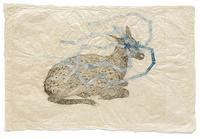
Everywhere (Sitting Fawn)
Kiki Smith
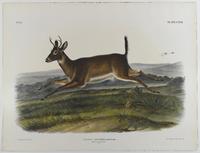
Long-Tailed Deer
John James Audubon
wildlife
Jessica Mozzini
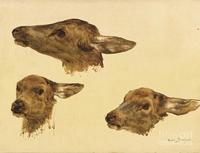
Three Studies of a Doe Head
Rosa Bonheur
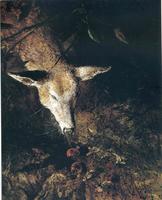
Untitled
Andrew Wyeth
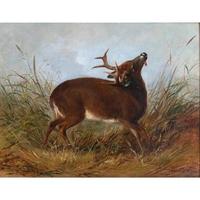
The Wounded Stag
Arthur Fitzwilliam Tait
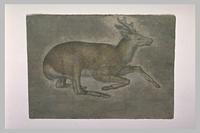
Sketch of young deer
Jacopo Bellini
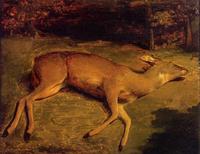
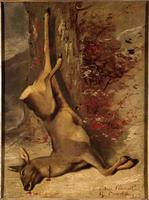
The Dead Doe
Gustave Courbet
The Deer
Gustave Courbet
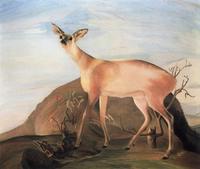
Deer
Tivadar Kosztka Csontvary
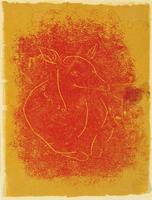
Doe
Sanyu
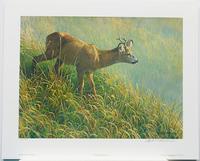
Morning Dew - Roe Deer
Robert Henry Roe
Roe deer fawn
Niko Pirosmani
Deer at the Edge of the Forest
Rosa Bonheur
A Little Boy Lost
Dorothy Lathrop
Study of Deer Heads
Rosa Bonheur
Human and them beast
Vannie Gama
Deer
John Singer Sargent