
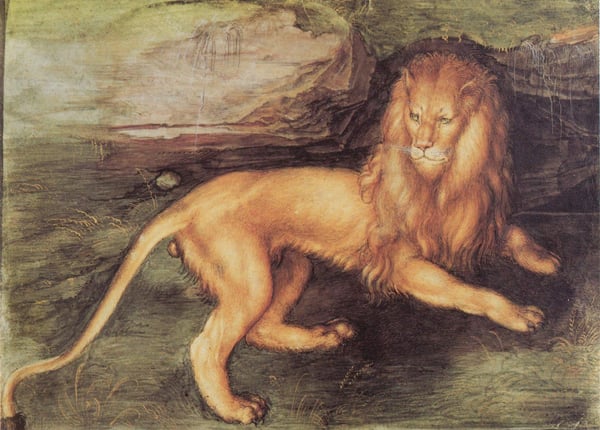
Analisi esperta di Lion di Albrecht Durer
Stile: Northern Renaissance · Genere: animal painting
Expert Analysis of "Lion" by Albrecht Dürer
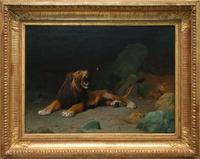
Albrecht Dürer’s Lion stands as a masterful exemplar of Northern Renaissance naturalism, blending empirical observation with the symbolic gravitas characteristic of the period. Although Dürer is best known for his painstaking studies of animals such as the Young Hare and the Rhinoceros, this animal painting demonstrates his unrivaled ability to transform a living creature into both a biological specimen and a resonant emblem.
Significance within the Northern Renaissance
The work belongs to a tradition in which artists sought to render the physical world with unprecedented fidelity—a hallmark of the Northern Renaissance. Dürer achieves this through meticulous attention to anatomy, fur texture, and the play of light across the lion’s mane and musculature. The lion is not merely depicted; it is studied, with every whisker and claw rendered through delicate pen-and-ink or engraving techniques that reveal Dürer’s expertise in linear definition and cross-hatching. This precision reflects the era’s fascination with the natural world as a source of divine truth, aligning with the humanist belief that close observation of nature could reveal God’s design.
Symbolic Dimension
Beyond naturalism, Dürer imbues the lion with layered allegorical meaning. In Renaissance iconography, the lion often symbolized strength, royalty, and the resurrected Christ (the “Lion of Judah”). Dürer’s portrayal, however, avoids overt heraldic stylization; instead, the animal’s tense posture and alert gaze suggest a raw, dignified power that is both earthly and spiritual. This duality—combining scientific accuracy with symbolic resonance—marks the work as a bridge between medieval bestiary traditions and modern natural history.
Technical Mastery
The quality of linework is extraordinary. Dürer uses fine, curving strokes to define the mane’s volume, while shorter, hatched marks articulate the smoother coat of the body. The eyes convey an unsettling directness, a trait Dürer perfected in his portraits and animal studies, forcing the viewer to confront the lion’s presence as both subject and symbol. This technical control, coupled with the composition’s balanced asymmetry, elevates the painting beyond mere illustration to a meditation on nature and meaning.
Conclusion
As a Northern Renaissance animal painting, Dürer’s Lion is significant for its synthesis of empirical detail and profound symbolism. It captures a moment when art, science, and faith converged, and it remains a testament to Dürer’s role as a pioneer who redefined how the natural world could be represented—and revered.
Visivamente simili
20 opere con composizione e palette affini
Lion
Jean-Baptiste Oudry
The Lion and the Fly
Jean-Baptiste Oudry
The Lion of St. Mark
Vittore Carpaccio
Allegory with a Virgin
Hans Memling
Lion devouring a piece of meat
Giorgio de Chirico
Lion of the Atlas
Eugene Delacroix
Sleeping Lioness
James Ward
Lion with lioness
Antonio Ligabue
Fight between a Lion and a Tiger
James Ward
Lion devouring an Arab horse
Eugene Delacroix
Lying Lions
Théodore Géricault
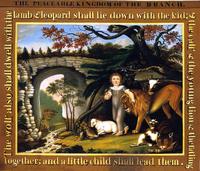
Peaceable Kingdom
Edward Hicks
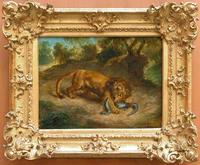
Lion and alligator
Eugene Delacroix
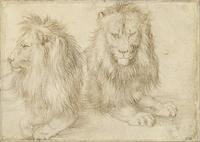
Two seated lions
Albrecht Durer
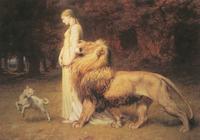
Una and Lion
Briton Riviere
Sketch for 'Daniel in the Lion's Den'
James Ward
Lion and boar
Eugene Delacroix
Phoebus Apollo
Briton Riviere
Lion and Prey (also known as The Kill)
Rosa Bonheur
Lion Snapping at a Butterfly
Jean-Leon Gerome