
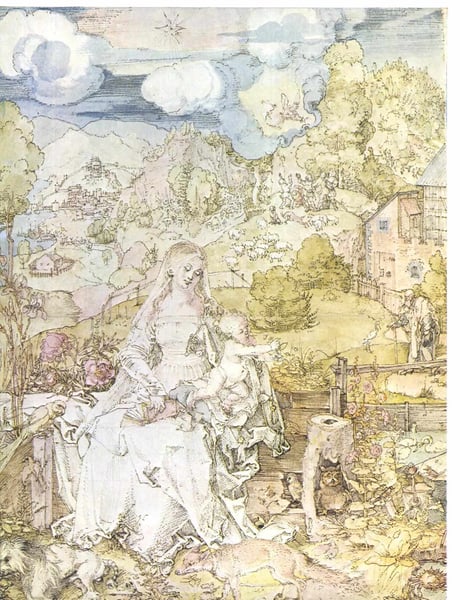
Analisi esperta di Madonna with the many animals di Albrecht Durer
Stile: Northern Renaissance · Genere: religious painting
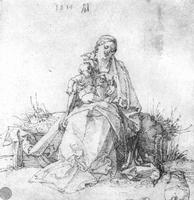
Albrecht Dürer’s "Madonna with the Many Animals" (also known as The Virgin with the Many Animals, c. 1503–1504) is a seminal work of the Northern Renaissance that exemplifies the period’s profound synthesis of meticulous naturalism with deep religious symbolism.
Significance within the Northern Renaissance:
-
Pioneering Naturalism: Dürer, already a master of engraving and printmaking, here demonstrates his unparalleled skill in watercolor and bodycolor on paper. The scene is not a stiff, hieratic icon but a lush, intimate landscape filled with dozens of precisely observed creatures—rabbits, birds, a hedgehog, a parrot, and even a horse—each rendered with the detailed accuracy of a naturalist. This reflects the Northern Renaissance fascination with empirical observation and the belief that God’s creation could be studied in its smallest details.
-
Symbolic Complexity: Unlike many contemporary Madonna depictions that foreground the holy figures against gold ground, Dürer embeds the Virgin and Child in a verdant, teeming garden. This setting evokes the Hortus Conclusus (enclosed garden) symbolizing Mary’s purity, while the multitude of animals serves a dual purpose: they are part of the earthly paradise and also act as memento mori or symbolic references. For example, the parrot can allude to the Virgin’s virginity or the Incarnation, and the hedgehog has been linked to thriftiness or the defense of faith—interpretations that Dürer leaves intentionally layered.
-
Technical Mastery: Dürer’s handling of light, texture, and color in this work is extraordinary. The soft, grassy foreground, the distant Alps, and the varied fur and feathers demonstrate the Northern Renaissance obsession with gründlichkeit (thoroughness). Yet he balances this micro-detail with a calm, pyramidal composition that centers Mary’s serene face and the playful Christ child, anchoring the chaotic multiplicity of life.
-
Devotional Innovation: By placing the holy family in a recognizable, living landscape rather than a static throne room, Dürer makes the divine accessible. The work invites the viewer to contemplate the incarnation as occurring within the same natural world we inhabit—a distinctly Northern humanist idea that marries late medieval piety with emerging Renaissance natural philosophy.
Thus, "Madonna with the Many Animals" is significant not only for its breathtaking beauty but for how it crystallizes the Northern Renaissance’s core achievement: using the closest possible observation of nature to illuminate the divine. Dürer transforms a traditional religious scene into a microcosm of creation itself, where every feather and leaf is a testament to both artistic skill and spiritual meaning.
Museum / Gallery
Visivamente simili
20 opere con composizione e palette affini
Madonna With The Monkey
Albrecht Durer
The Holy Family with angels under trees
Albrecht Durer
Holy Family with three Hares
Albrecht Durer
Holy Family
Albrecht Durer
Madonna and Child with John the Baptist
Albrecht Durer
Madonna Crowned By An Angel
Albrecht Durer
Mary at the gate
Albrecht Durer
Mary and Child, crowned by an angel and St. Anna
Albrecht Durer
The holy family with the dragon fly
Albrecht Durer
Studies on a great "picture of the Virgin" Madonna and Child, saints and angels playing
Albrecht Durer
Virgin and Child
Matthias Grünewald
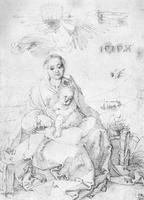
Madonna and child on the grassy bank
Albrecht Durer
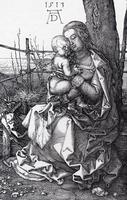
Madonna By The Tree
Albrecht Durer
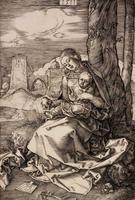
Mary with a pear
Albrecht Durer
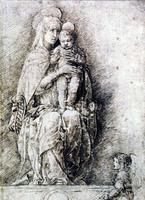
Virgin and Child
Andrea Mantegna
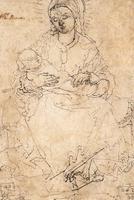
Madonna and Child on a Stone Bench
Albrecht Durer
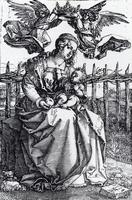
Madonna Crowned By Two Angels
Albrecht Durer
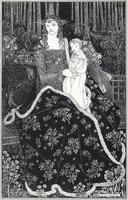
A large Christmas Card
Aubrey Beardsley
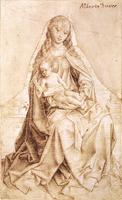
Virgin with the Blessing Child
Rogier van der Weyden
Madonna and child on the grassy bank
Albrecht Durer