
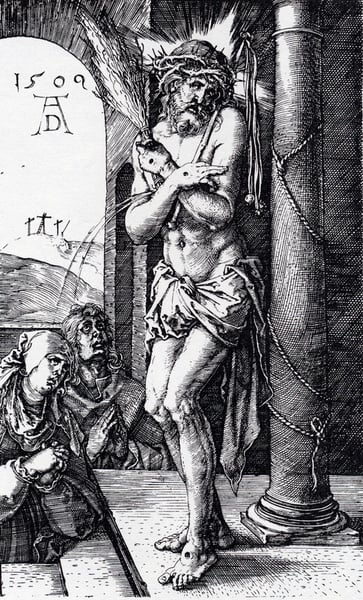
Analisi esperta di Man Of Sorrows By The Column (Engraved Passion) di Albrecht Durer
Stile: Northern Renaissance · Genere: religious painting
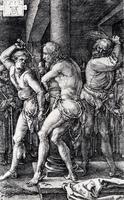
Expert Analysis: "Man Of Sorrows By The Column (Engraved Passion)" by Albrecht Dürer
Albrecht Dürer’s Man of Sorrows by the Column, part of his celebrated Engraved Passion series (1507–1512), stands as a masterwork of the Northern Renaissance—a period defined by its fusion of meticulous naturalism with profound religious introspection. This engraving is significant for several reasons that highlight Dürer’s unrivaled technical mastery and his ability to infuse a traditional devotional subject with human pathos and symbolic depth.
1. Technical Virtuosity in Engraving Dürer revolutionized printmaking, and this piece exemplifies his near-sculptural control of line and tone. Using only the burin, he models Christ’s tormented body with exquisite chiaroscuro—the interplay of light and shadow achieved through cross-hatching and parallel lines. The column, a classical architectural element, is rendered with geometric precision, contrasting with the organic, wounded flesh of Christ. The meticulous detail of the crown of thorns, the rivulets of blood, and the texture of the loincloth demonstrate Dürer’s ability to achieve sculptural volume and emotional gravity on a flat copper plate, elevating engraving to a fine art.
2. Northern Renaissance Naturalism and Devotional Intimacy Unlike the idealized, often serene Italian depictions of the Man of Sorrows, Dürer grounds the scene in gritty, palpable reality. Christ’s haggard face, closed eyes, and the pronounced wounds (hands, side, feet) are rendered with almost clinical precision, inviting the viewer into a direct, meditative encounter with suffering. This aligns with Northern Renaissance piety, which emphasized empathy for Christ’s humanity as a path to salvation. The column—traditionally a symbol of the flagellation—is not merely a prop but a cold, hard monument that isolates the figure, emphasizing his vulnerability.
3. Synthesis of Northern and Italian Influences Dürer traveled to Italy and absorbed Renaissance principles of proportion and perspective, yet he retained the Northern love for symbolic detail. Here, the column’s classical fluting and the subtle recession of space (note the floor’s orthogonal lines) reflect Italian compositional ideas, while the emotional immediacy and the almost forensic rendering of wounds are distinctly Northern. This synthesis makes the work a landmark of the Dürerzeit, where Gothic tradition met humanist inquiry.
4. Significance within the Engraved Passion Series This print is the emotional and theological fulcrum of the series. By isolating Christ before the Crucifixion (the moment of crowning with thorns and flagellation), Dürer focuses on the Passion as a continuous, lived experience of pain, rather than a single event. The engraving’s intimate scale—designed for private devotion—allowed collectors and pious laypeople to hold Christ’s suffering in their hands, making the divine accessible through Dürer’s unmatched skill.
Conclusion Man of Sorrows by the Column is significant not only as a technical tour de force but as a profound statement of Northern Renaissance spirituality. It captures the era’s core tension: the desire to render the divine with earthly truth. Dürer’s ability to make every engraved line convey humiliation, agony, and quiet transcendence ensures this work remains a touchstone for understanding how art can translate theology into unforgettable visual form.
Museum / Gallery
Visivamente simili
20 opere con composizione e palette affini
Ecce Homo
Albrecht Durer
Christ on the Cross
Albrecht Durer
Crucifixion
Albrecht Durer
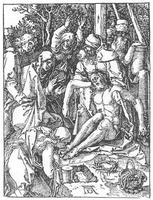
The Lamentation for Christ
Albrecht Durer
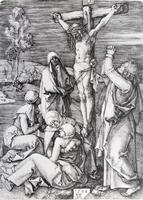
Crucifixion
Albrecht Durer
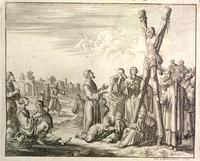
Crucifixion of Apostle Andrew, Patras in Achaia, AD 70
Jan Luyken
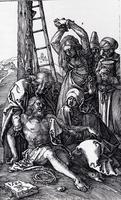
Lamentation Over Christ
Albrecht Durer
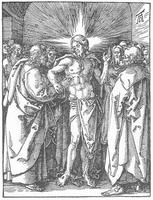
The Incredulity of St Thomas
Albrecht Durer
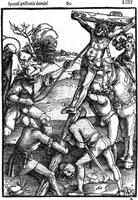
The Erection of the Cross
Hans Baldung
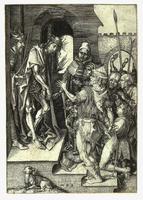
Ecce Homo
Martin Schongauer
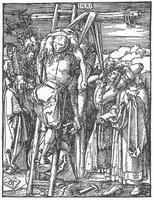
The Descent from the Cross
Albrecht Durer
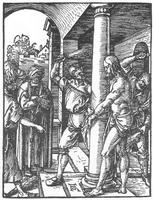
The Flagellation
Albrecht Durer
Vision of the Crucifixion
Sebastiano Conca
Ecce Homo
Palma il Giovane
Christ on the Cross with the Virgin and St John
Albrecht Durer
Crucifixion
Albrecht Durer
Christ crucified between the two thieves an oval plate
Rembrandt
Entombment Copperplate
Martin Schongauer
Crucifixion
Hans Baldung
Flagellation
Albrecht Durer