
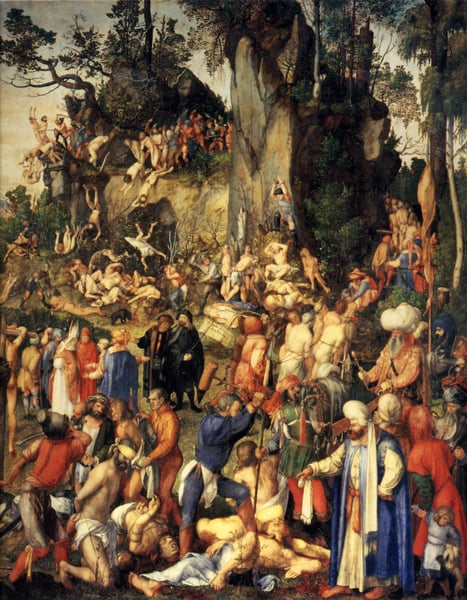
Albrecht Durer sanatçısının Martyrdom of the Ten Thousand eseri hakkında uzman analizi
Tarz: Northern Renaissance · Tür: religious painting
Expert Analysis: "The Martyrdom of the Ten Thousand" by Albrecht Dürer (Northern Renaissance, Religious Painting)
Albrecht Dürer’s The Martyrdom of the Ten Thousand (1508) stands as a masterwork of the Northern Renaissance, a period defined by its fusion of meticulous naturalism, symbolic complexity, and emerging humanist influence. This religious painting depicts the legendary mass execution of ten thousand Christian soldiers on Mount Ararat under the Roman emperor Hadrian—a subject chosen by Dürer for its profound spiritual and emotional resonance.
Significance within the Northern Renaissance:
-
Unprecedented Detail and Spatial Mastery – Dürer synthesizes the Northern tradition of hyper-detailed observation with the Italianate understanding of perspective and anatomy. The canvas teems with dozens of figures, each individually rendered with lifelike expressiveness, from anguished faces to contorted bodies. The landscape unfolds in deep, layered planes—craggy mountains, distant castles, and ominous skies—demonstrating Dürer’s ability to create a coherent, expansive space that draws the viewer’s eye across the entire tragedy.
-
Emotional Intensity and Theatricality – Unlike earlier, static depictions of martyrdom, Dürer composes the scene as a chaotic, multi-narrative tableau. Torturers wield clubs, swords, and hooks; victims are crucified, beheaded, or stoned. Yet amidst the violence, individual acts of faith stand out—a bishop blessing a kneeling man, a saintly figure praying as soldiers close in. This duality of brutality and serenity reflects the Northern Renaissance’s preoccupation with human suffering and divine redemption.
-
Inclusion of the Artist as a Witness – Dürer famously inserts his own self-portrait into the center-right, holding a banner that reads “Albertus Dürer Noricus.” This act asserts the artist’s role not only as creator but as moral commentator—a bold humanist statement. By placing himself among the martyrs, Dürer aligns his art with spiritual witness, a hallmark of the Northern Renaissance’s emphasis on personal piety and the artist’s elevated status.
-
Printmaking Influence on Painting – Dürer, primarily a printmaker, brings graphic precision to this oil painting. The fine lines, cross-hatching-like textures, and sharp contrasts of light and dark reveal his woodcut and engraving background. This cross-medium expertise allowed him to achieve a level of detail unprecedented in large-scale religious painting, influencing later Northern artists like Hans Baldung Grien and Albrecht Altdorfer.
-
Document of Religious Turmoil – Painted during the early Reformation, the work reflects the era’s anxieties about persecution and true faith. Dürer, a devout Lutheran sympathizer, channels contemporary fears of martyrdom into an ancient allegory. The chaotic composition suggests a world where order collapses under tyranny, yet the steadfastness of the saints offers a model of resilience. This political and spiritual subtext makes the painting a crucial record of Northern Renaissance thought.
In summary, The Martyrdom of the Ten Thousand is significant not merely for its technical virtuosity but for its synthesis of Northern realism, Italian spatial logic, and deep religious engagement. It exemplifies Dürer’s genius in transforming a gruesome subject into a compassionate, intellectually layered meditation on faith, art, and humanity—a quintessential achievement of the Northern Renaissance.
Museum / Gallery
Görsel olarak benzer
İlişkili kompozisyon ve renk paletine sahip 20 eser
The Temptation of Saint Anthony
Jan Brueghel the Elder
Adoration of the Magi
Jacopo Pontormo
Martyrdom of St. Hippolytus - the central panel from St. Hippolytus Triptych
Dirk Bouts
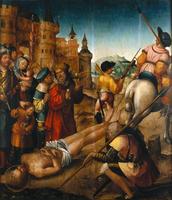
Martírio de Santo Hipólito
Cristovao de Figueiredo
The Triumph of Death
Jan Brueghel the Elder
Moses and the Israelites After the Miracle of Water from the Rock
Lucas van Leyden
Altar triptych from the Lübeck Cathedral (detail)
Hans Memling
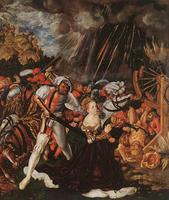
The Martyrdom of St. Catherine
Lucas Cranach the Elder
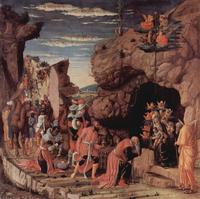
Adoration of the Magi, central panel from the Altarpiece
Andrea Mantegna
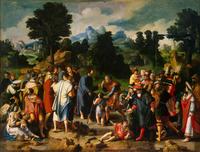
Christ Healing the Blind Man of Jericho
Lucas van Leyden
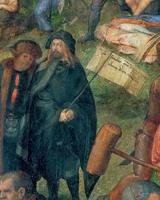
Martyrdom of the Ten Thousand (detail, Supposed Self Portrait)
Albrecht Durer
Adoration of the Shepherds
Luca Signorelli
Saint Paul Conduit À Damas Après Sa Conversion
Pieter Brueghel the Younger
The Frankfurt Altarpiece of the Holy Cross
Adam Elsheimer
The Sermon of St. John the Baptist
Pieter Bruegel the Elder
Martyrdom of the Twelve Apostles (Altarpiece for the Church of the Holy Apostles in Cologne, left wing)
Stefan Lochner
Scenes from the Life of St. Mary Magdalene
Lucas van Leyden
Passion Altarpiece (side wings)
Dirk Bouts
Altar polyptych of San Bartolomeo, Bergamo, foot plate: Martyrdom of St. Stephen
Lorenzo Lotto
The Crucifixion
Lucas Cranach the Elder