
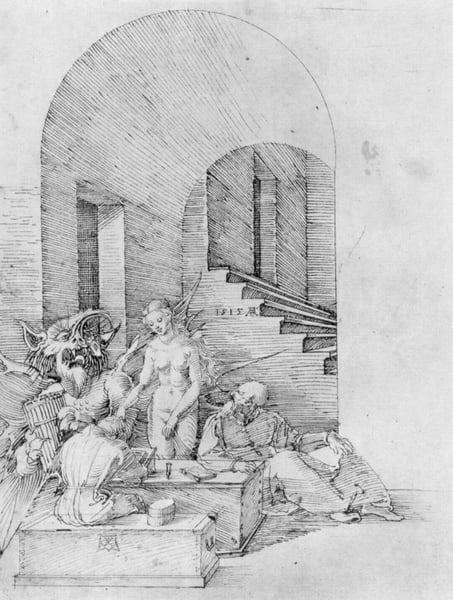
Temptation
Expert analysis of Albrecht Durer’s Temptation
Style: Northern Renaissance · Genre: religious painting
Expert Analysis of "Temptation" by Albrecht Dürer
Albrecht Dürer’s “Temptation” stands as a quintessential example of the Northern Renaissance’s fusion of meticulous naturalism with profound religious allegory. Although Dürer is celebrated for his engravings, this painting—executed with the same precision that defines his graphic work—demonstrates his unparalleled ability to render spiritual drama through tangible, everyday detail.
Composition and Symbolism
The scene likely depicts a moment of moral testing, a common theme in Northern Renaissance religious painting. Dürer employs a dense, layered composition typical of the period: a foreground figure (perhaps a sleeping or slothful character) surrounded by demonic or worldly temptations. The inclusion of a stove, a bundle of straw, and a floating demon with a bellows—motifs familiar from Dürer’s own engravings like The Dream of the Doctor—anchors the allegory in domestic reality. Every object carries symbolic weight: the stove suggests the warmth of sin, the bellows represents idle chatter or false inspiration, and the sleeping posture warns against spiritual lethargy (acedia).
Technical Mastery
Dürer’s brushwork here rivals his famous linework. The surfaces—textured fabrics, glinting metal, soft flesh—are rendered with a microscopic fidelity that reveals his training in goldsmithing and printmaking. This hyperrealism serves the theological message: evil is not a distant abstraction but an intimate, tangible presence. The chiaroscuro modeling, influenced by his travels to Italy, gives volume to forms while the crisp outlines retain a Germanic precision—a hallmark of Northern Renaissance synthesis of Flemish oil technique and Italianate monumentality.
Significance within the Northern Renaissance
“Temptation” is significant because it exemplifies the shift from late medieval didacticism to a more psychological, human-centered spirituality. Dürer does not simply illustrate a Bible story; he constructs a moral landscape where the viewer is implicated. The painting’s ambiguity—is the figure tempted by the demon, or is he dreaming?—invites introspection, a key innovation of Northern Renaissance art. Furthermore, it demonstrates Dürer’s role as a cultural bridge: the expressive intensity of the demon figures recalls the fantastic creatures of Hieronymus Bosch, while the balanced composition and classical references show his engagement with Italian humanism. In this single work, we see the Northern Renaissance’s core concerns: the tension between faith and reason, the material world as a veil for the divine, and the artist as a moral commentator. Dürer’s “Temptation” remains a vital document of how art can transform a religious warning into a timeless psychological drama.
Visually similar
20 works with related composition and palette
Christ in Limbo
Albrecht Durer
The Adoration of the Magi
Maerten van Heemskerck
Harrowing Of Hell
Albrecht Durer
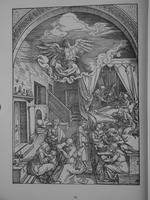
A Life of the Virgin
Albrecht Durer
Cambyses Commanding the Flaying of Judge Sisamnes
Willem van Swanenburg
Christ Being Crowned with Thorns
Albrecht Durer
Illustration to "A Week of Kindness"
Max Ernst
Women only
Albrecht Durer
Mercury protecting Ulysses from the charms of Circe
Annibale Carracci
The Firstborn of the Egyptians Are Slain
Gustave Dore
The Lupercalian Festival in Rome. Cupid and Personifications of Fertility Encounter the Luperci Dressed as Dogs
Adam Elsheimer
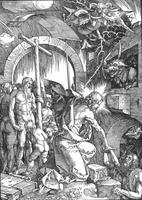
The Harrowing of Hell or Christ in Limbo, from The Large Passion
Albrecht Durer
Hope
Lucas van Leyden
Molorchos making a sacrifice to Hercules
Andrea Mantegna
Tobias and his blind father
Orest Kiprensky
Antenora, Ugolino with his sons in the Tower of Hunger
Joseph Anton Koch
Sower of Discord
Gustave Dore
The Virgin Worshipped by Angels and Saints
Albrecht Durer
Crowning with Thorns
Albrecht Durer
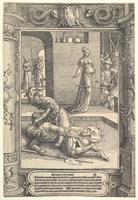
Jael Killing Sisera, Ornamental Frame
Lucas van Leyden