
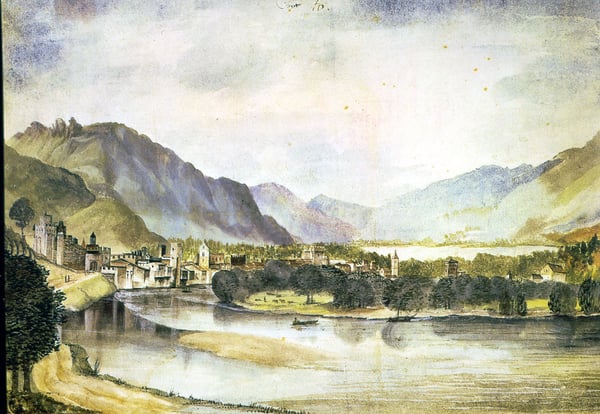
Expert analysis of Albrecht Durer’s The city of Trento
Style: Northern Renaissance · Genre: cityscape
Expert Analysis: "The City of Trento" by Albrecht Dürer
Albrecht Dürer’s The City of Trento stands as a masterful example of the Northern Renaissance cityscape genre, demonstrating the artist’s profound skill in merging meticulous observational detail with the emerging principles of spatial organization. Painted during Dürer’s first trip to Italy (1494–1495), this work captures the alpine town of Trento with remarkable topographical precision, yet it transcends mere documentation.
Significance within the Northern Renaissance:
Dürer’s cityscape is significant for its synthesis of Northern European graphic tradition—characterized by intricate linework and a near-scientific attention to natural and architectural forms—with Italianate perspective and atmospheric depth. The composition leads the viewer’s eye from the fortified walls and clustered roofs in the foreground, through the valley, to the distant mountains, demonstrating an early grasp of aerial perspective. This blending of Northern detail (every window, crenellation, and hillside is carefully articulated) with Southern spatial coherence marks a pivotal moment in Renaissance landscape painting.
Genre and Period Context:
As a pure cityscape—a relatively rare subject for the era—The City of Trento anticipates the independent landscape and veduta traditions of later centuries. Dürer treats the city not as a backdrop for religious or historical narrative but as the primary subject, imparting it with a sense of place and transient light. The work underscores Dürer’s role as a bridge between the late Gothic attention to minutiae and the Renaissance quest for harmonious, rational depiction of the visible world. It remains a touchstone for the Northern Renaissance’s contribution to landscape and topographic art.
Museum / Gallery
Visually similar
20 works with related composition and palette
Nablus
David Roberts
Rustic Market
Pieter Bruegel the Elder
Crafty Bird Catcher
Pieter Bruegel the Elder
Shumen
Felix Philipp Kanitz
Route du Limaçon
Maxime Lalanne
Berner Oberland
Joseph Anton Koch
The town Zell on the Moselle River in Germany
Karl Bodmer
A Lake and Mountains in Westmorland
Thomas Girtin
Luchon, (Vue prise de Bellevue)
Maxime Lalanne
Rheinische Flusslandschaft mit Lastkähnen
Gustav Kraus
A Winding Estuary
Thomas Girtin
Vues dans L'Empire Ottoman
Luigi Mayer
Go ye into the Emmaus
Pieter Bruegel the Elder
Ehrenbreitstein and Coblenz
J.M.W. Turner
Mountainous landscape with river valley and travellers towards a large city
Tobias Verhaecht
Mountains
Martiros Sarian
Ingleborough From The Terrace Of Hornby Castle
J.M.W. Turner
The Hare Hunt
Pieter Bruegel the Elder
Tübingen Von Keller Und Seyffer
August Seyffer
La Vile De Bergen Prise D' Une Batterie Nommé Hæggrénsset
Christian August Lorentzen