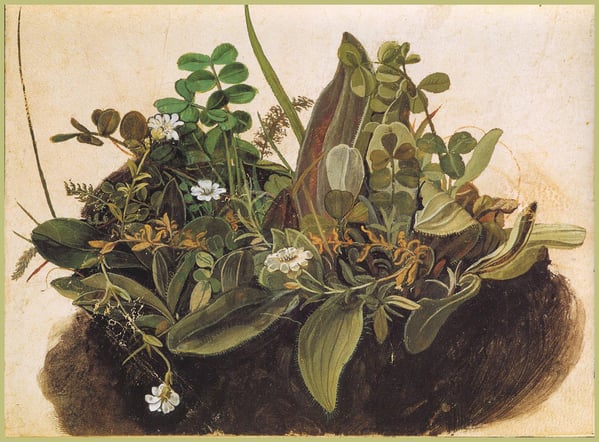
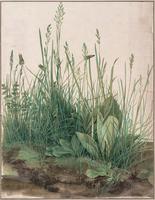
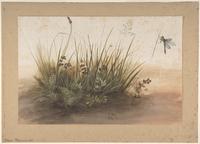
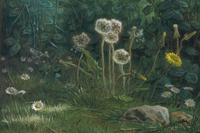
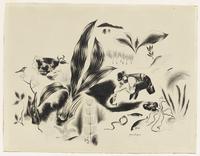
"The Tuft of Grass (Minor)" exemplifies Albrecht Dürer's groundbreaking approach to naturalistic observation during the Northern Renaissance. While Dürer's larger "Great Piece of Turf" (1503) is more widely known, this smaller study underscores the same revolutionary departure from idealized, symbolic plant imagery—a hallmark of Northern Renaissance artists who prioritized empirical detail over religious allegory.
Executed in watercolor and gouache, the work captures a seemingly humble cluster of grasses, dandelion leaves, and yarrow with scientific precision and painterly sensitivity. Each blade and leaf is rendered with distinct texture, curvature, and tonal variation, revealing Dürer's direct study from nature rather than from stylized conventions. The vertical, almost specimen-like composition invites close inspection, as if the viewer is an early modern naturalist peering at a microcosm of creation.
Significantly, "The Tuft of Grass (Minor)" stands as a precursor to the botanical illustration genre and reflects the Renaissance spirit of inquiry—where art and emerging natural science converged. Dürer's ability to elevate an overlooked patch of earth into a subject of profound beauty and meticulous realism marks a pivotal moment in the history of flower painting, moving it from decorative marginalia to a legitimate focus of artistic mastery. This work remains a testament to Dürer's conviction that the divine could be discerned in the meticulous study of the natural world.