Analisi esperta di Willow Mill di Albrecht Durer
Stile: Northern Renaissance · Genere: landscape
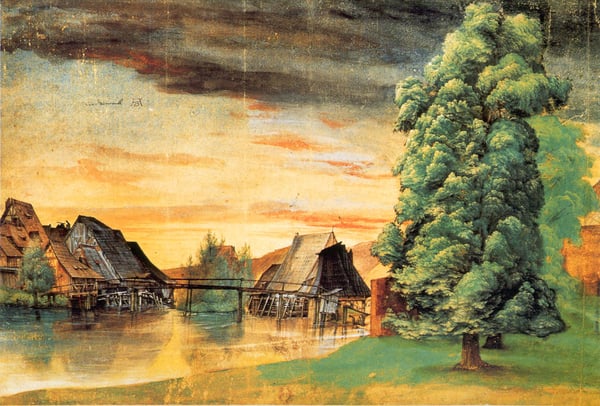
"Willow Mill" (c. 1496–1498) by Albrecht Dürer is a landmark work of the Northern Renaissance, executed in watercolor and gouache on paper. While Dürer is better known for his prints, this delicate landscape study demonstrates his groundbreaking approach to nature as an independent subject—long before landscape became a recognized genre in European art.
Significance within the Northern Renaissance style:
Dürer’s meticulous observation of natural detail epitomizes the Northern Renaissance fascination with empirical reality. The painting captures a specific mill near Nuremberg with almost botanical precision: each willow leaf, clump of reeds, and wooden support is rendered with the same exactitude found in his famous nature studies like The Great Piece of Turf. Yet Dürer also employs an early form of atmospheric perspective—softening the distant hills and sky with washes of blue and green—creating a unified, breathing space that feels both observed and composed. This synthesis of scientific scrutiny and painterly sensitivity was revolutionary for its time.
What makes it pioneering:
At the end of the 15th century, landscape was typically relegated to backgrounds for religious or historical scenes. Dürer’s Willow Mill is among the earliest surviving European artworks to treat a purely secular, everyday view as worthy of a finished painting. Its loose, fluid brushwork—using transparent watercolor for the sky and opaque gouache for foreground textures—foreshadows the fluidity of later watercolor traditions. The composition, with its diagonal millrace leading the eye through layered planes, reveals Dürer’s deep understanding of how to guide a viewer’s gaze, a device he honed in his prints.
In historical context:
This work reflects Dürer’s travels and his desire to record the countryside around Nuremberg, combining local topography with an almost romantic sensitivity to light and season. It stands as a direct precursor to the independent landscape traditions of the 17th-century Dutch Golden Age, and it demonstrates why Dürer is considered the bridge between Gothic detail and the humanistic, observation-driven spirit of the Northern Renaissance.
Museum / Gallery
Visivamente simili
20 opere con composizione e palette affini
Landscape with a View of Antwerp
Hans Bol
Farmyard
Jan Brueghel the Younger
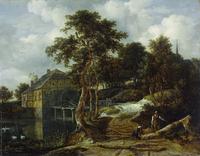
Landscape with watermill
Jacob van Ruisdael
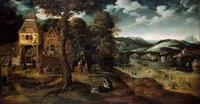
Landscape with The Flight into Egypt
Joachim Patinir
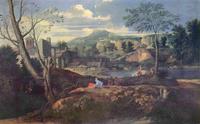
Ideal Landscape
Nicolas Poussin
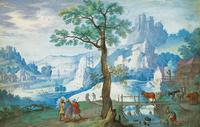
Landscape With Christ On The Road To Emmaus, A Woman Herding Cattle To The Right
Hans Bol
View near Llangaddock, Carmarthenshire
Charles Martin Powell
Landscape with a Footbridge
Albrecht Altdorfer
Village Scene with Men Drinking
Adriaen Brouwer
The Trefilería on Peignitz
Albrecht Durer
A River Running Through a Small Town
Jan Brueghel the Elder
Landscape with the story of Jephthah’s daughter
Jacob Savery the Elder
Landscape with Mill
Paul Cezanne
Mealtime in the Country
Pieter Brueghel the Younger
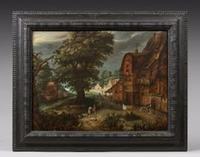
Shepherd and his flock in a village
Jan Brueghel the Younger
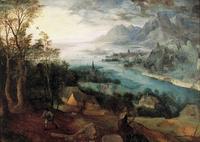
Parable of the Sower
Pieter Bruegel the Elder
The Temptation of St. Anthony (detail)
Hieronymus Bosch
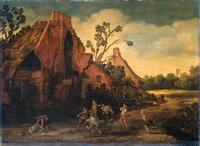
The robbery
Esaias van de Velde
Landscape with a fisherman
Rembrandt
Panneau de chêne, une planche, non parqueté
Jacob Grimmer