
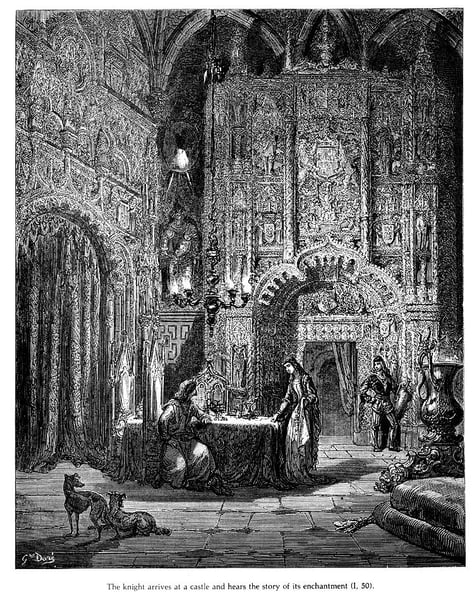
Expert analysis of Gustave Dore’s Don Quixote
Style: Romanticism · Genre: illustration
Expert Analysis: "Don Quixote" by Gustave Doré
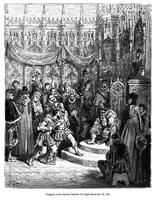
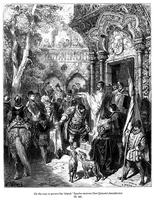
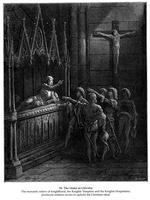
Gustave Doré’s illustration for Don Quixote stands as a quintessential example of Romanticism in the realm of book illustration. While the facts provided do not specify a particular scene, Doré’s treatment of Cervantes’s narrative encapsulates the Romantic fascination with imagination, individuality, and the sublime—often conveyed through dramatic contrasts of light and shadow, expressive figures, and a heightened sense of atmosphere.
Significance within Romanticism
Doré’s work channels the Romantic ethos by elevating a literary character—Don Quixote—into an emblem of the solitary dreamer battling an indifferent world. The illustration likely employs chiaroscuro (strong contrasts between light and dark) to emphasize the knight’s gaunt, heroic silhouette against vast, often bleak landscapes. This visual treatment mirrors Romanticism’s obsession with the individual’s emotional journey, the power of the irrational, and the tension between reality and illusion. Doré’s decision to illustrate the novel also aligns with Romanticism’s valorization of folklore, medievalism, and national identity, as Cervantes’s work itself critiques and celebrates chivalric romance.
Significance within the Illustration Genre
Doré revolutionized book illustration by treating it as a fine art, not merely a decorative accessory. His Don Quixote plates (over 370 in the 1863 French edition) are celebrated for their narrative depth, technical virtuosity, and psychological acuity. Each illustration functions as a standalone Romantic tableau: characters are often dwarfed by monumental skies, windmills, or architectural ruins, evoking the sublime—a key Romantic concept. The linework is both meticulous and fluid, capturing movement and emotion with an almost cinematic sense of drama. Doré’s ability to infuse a text-dependent medium with the grand ambition of history painting elevated the status of illustration, influencing generations of visual storytellers from cinema to comic art.
Conclusion
Doré’s Don Quixote is significant because it synthesizes Romanticism’s core passions—individual struggle, imaginative freedom, and the awe-inspiring power of nature—within the accessible format of the illustrated book. It remains a benchmark for how illustration can achieve the emotional and symbolic weight of a major painting, while simultaneously advancing the Romantic ideal that art should stir the soul and challenge the boundaries of the real.
Visually similar
20 works with related composition and palette
Don Quixote
Gustave Dore
Building of the Temple of Jerusalem
Jean Fouquet
Monumento Sepolcrale Di Guido Tarlati Nella Cattedrale
Giuseppe Barberis
Solomon Receives the Queen of Sheba
Gustave Dore
Don Quixote
Gustave Dore
St. Erasmus in Bishop Islips Chapel, Westminster Abbey
J.M.W. Turner
Mausoleo Colleoni, Nella Cappella Omonima
Giuseppe Barberis
Don Quixote
Gustave Dore
The Interior of Henry VII Chapel in Westminster Abbey
Canaletto
An Interior View of the Henry VII Chapel Westminster Abbey
Canaletto
The Circumcision of Christ
Albrecht Durer
The Presentation of the Virgin
Limbourg brothers
Rhenströmmen från Cöln till Maynz
Carl Johan Billmark
Interior of Salisbury Cathedral
J.M.W. Turner
Pórtico de la Gloria, Santiago de Compostela Cathedral
Jenaro Pérez Villaamil
The Order of Chivalry
Gustave Dore
Altar Design for the Augsburg Cathedral
Hans Holbein the Elder
Sketches of a trip to Spain: Capilla de Villaviciosa
John Frederick Lewis
The Curtain Sketch of the play La Ronde des Heures
Konstantin Korovin
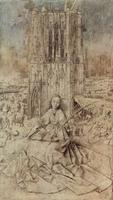
St. Barbara
Jan van Eyck