
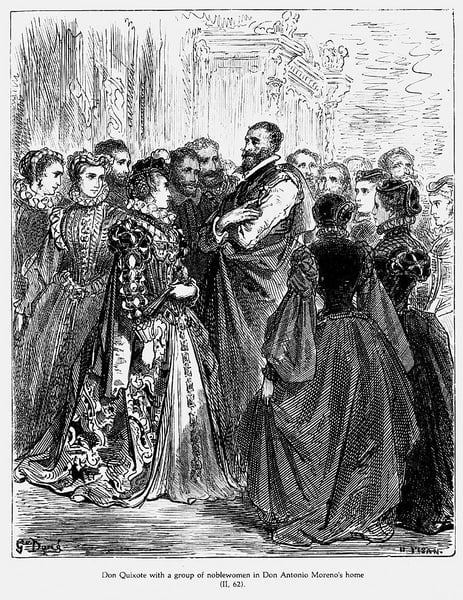
Expert analysis of Gustave Dore’s Don Quixote
Style: Romanticism · Genre: illustration
Expert Analysis: Don Quixote by Gustave Doré
Gustave Doré’s illustrations for Miguel de Cervantes’ Don Quixote stand as a definitive visual interpretation of the novel, deeply rooted in the Romanticism movement while serving a distinctly illustrative purpose. Doré’s work is significant not merely as decoration, but as a lens through which the Romantic era’s core values—imagination, emotion, and the grandeur of the individual spirit—are brought into sharp focus.
Romantic Dramatization of the Absurd Hero
Doré elevates the novel’s protagonist, Alonso Quijano (Don Quixote), from a comical figure into a tragic, heroic archetype. In his illustrations, Quixote is often depicted as a gaunt, spectral figure astride his broken-down horse, Rocinante. Doré uses dramatic chiaroscuro—deep shadows against stark light—to heighten the pathos and grandeur of Quixote’s delusions. The windmill scene, for example, becomes less a farce and more an epic, almost mythical confrontation. The towering, jagged forms of the windmills are rendered with a sublime scale, dwarfing the frail knight and emphasizing the Romantic fascination with the struggle between human aspiration and an indifferent, overwhelming nature.
Genre as a Vehicle for Emotional Depth
Although executed as an illustration—a genre often dismissed as secondary to fine art—Doré’s Don Quixote series demonstrates the power of illustration to convey complex psychological and emotional states. His linework is both meticulous and expressive, capturing not only the physical action but the inner turmoil of the characters. The drawing of Quixote reading in his library, surrounded by chaotic piles of books, is a masterful portrayal of obsessive imagination. Doré uses intricate cross-hatching and a somber tonal range to suggest the melancholy and isolation that underpin Romantic heroism.
Significance within Romanticism and Visual Culture
Doré’s illustrations for Don Quixote became so iconic that they shaped the public’s visual imagination of the characters for generations. They exemplify how Romantic artists turned to literature for inspiration, creating a symbiotic relationship between text and image. Doré’s work transcends mere accompaniment; it is an independent artistic achievement that captures the novel’s dual nature—its humor and its profound sorrow, its critique of reality and its yearning for an ideal world. In this, Doré’s Don Quixote remains a benchmark for how art can visualize the Romantic ideal of the misunderstood visionary, forever tilting at impossible, yet noble, windmills.
Visually similar
20 works with related composition and palette
Don Quixote
Gustave Dore
Don Quixote
Gustave Dore
Don Quixote
Gustave Dore
Faust meeting Marguerite
Eugene Delacroix
Marie Princesse De Pologne Reine De France Et De Navarre
Jean-Baptiste van Loo
Maria Stuart’s Abschied von ihren Getreuen
Wilhelm von Kaulbach
Taste in High Life
William Hogarth
Don Quixote
Gustave Dore
Cinderella
Gustave Dore
Les Parents Terribles series: This one paints...
Paul Gavarni
Illustration
Adriaen van de Venne
Erin Nuremberg and Venetian
Albrecht Durer
A Harlot's Progress, plate 1
William Hogarth
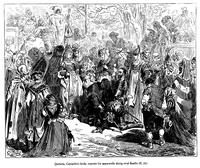
Don Quixote
Gustave Dore
Marie Zu Hohenlohe
Wilhelm von Kaulbach
What are you looking for here, Philosopher?
Paul Gavarni
Leaving the Theater
Constantin Guys
James I and his royal progeny
Charles Turner
UNDER THE MISTLETOE
John Leech
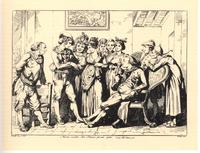
Nuccia accepts Meo Patacca for her husband (Plate 52/52)
Bartolomeo Pinelli